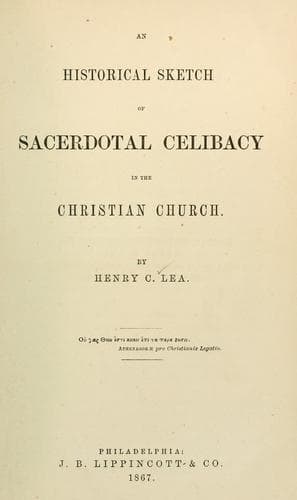
An Historical Sketch of Sacerdotal Celibacy in the Christian ChurchLea, Henry Charles
History
An Historical Sketch of Sacerdotal Celibacy in the Christian Church
Lea, Henry Charles
Catholic Church -- Clergy; Celibacy -- Catholic Church; Church history
As the excuse for the rebellion was the necessity of restoring the
empire to the communion of Rome, one of the first measures of the
conspirators was the convocation of a council to be held at Nordhausen,
May 29, 1105, and one of the objects specified for its action was the
expulsion of all married priests.[575] The council was duly held,
and duly performed its work of condemning the heresy which permitted
benefices to be occupied and sacred functions exercised by those who
were involved in the ties of matrimony.[576] Pope Paschal II. was not
remiss in his share of the ceremony, by which he was to receive the
fruits of his treacherous intrigues. The following year a great council
was held at Guastalla, where, after interminable discussions as to the
propriety of receiving without re-ordination those who had compromised
themselves or who had been ordained by schismatics, he admitted into
the fold all the repentant ecclesiastics of the party of Henry IV.[577]
The text of the canon granting this boon to the imperialist clergy
bears striking testimony to the completeness of the separation which
had existed between the Teutonic and the Roman churches in stating that
throughout the empire scarce any Catholic ecclesiastics were to be
found.[578] It scarcely needed the declaration which Paschal made in
1107 at the synod of Troyes, condemning married priests to degradation
and deprivation,[579] to show that the doctrines of Damiani and
Hildebrand were thenceforth to be the law of the empire.
The question thus was definitely settled in prohibiting the priests
of Germany from marrying or from retaining the wives whom they had
taken previous to ordination. It was settled, indeed, in the rolls
of parchment which recorded the decrees of councils and the trading
bargains of pope and kaiser, yet the perennial struggle continued, and
the parchment roll for yet awhile was powerless before the passions of
man, who did not cease to be man because his crown was shaven and his
shoulders wore cope and stole.
Public-domain text, read in full here on John Shaqi.
Reviews
Reviews
No reviews yet
Be the first to share your thoughts on this work.
Elsewhere in the archive
Join the Discussion
Join the discussion
Sign in to leave a comment or review.
Sign InorCreate an account