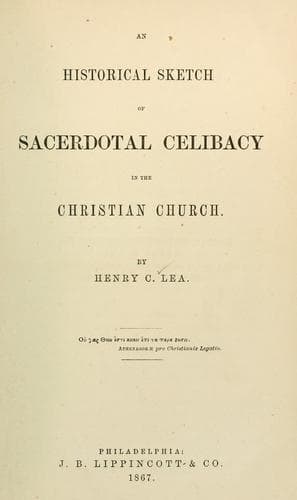
An Historical Sketch of Sacerdotal Celibacy in the Christian ChurchLea, Henry Charles
History
An Historical Sketch of Sacerdotal Celibacy in the Christian Church
Lea, Henry Charles
Catholic Church -- Clergy; Celibacy -- Catholic Church; Church history
I have not met with any indications of the results of the legislation
which thus combined the influence of the temporal and ecclesiastical
authorities. That it effected little, however, is apparent from the
evidence afforded by Dalmatia, at that time a province of Hungary.
Shortly before it lost its independence, its duke, Dimitri, resolved
to assume the crown of royalty, and purchased the assent of Gregory
VII. at the price of acknowledging him as feudal superior. Gregory took
advantage of Dimitri’s aspirations to further the plans of reform, of
which he never lost sight; for, in the coronation oath taken in 1076
before Gebizo, the papal legate, the new king swore that he would take
such measures as would insure the chastity of all ecclesiastics, from
the bishop to the subdeacon.[595] The new dynasty did not last long,
for before the end of the century St. Ladislas united the province of
Dalmatia to the kingdom of Hungary; but neither the oath of Dimitri,
the laws of Coloman, nor the canons of the national councils succeeded
in eradicating the custom of priestly marriage. When we find, in 1185,
Urban III. in approving the acts of the synod of Spalatro, graciously
expressing his approbation of its prohibiting the marriage of priests,
and desiring that the injunction should be extended so as to include
the diaconate,[596] we see that marriage must have been openly enjoyed
by all ranks, that the synod had not ventured to include in the
restriction any but the highest order, and that Urban himself did not
undertake to apply the rule to subdeacons, although they had been
specially included in Dimitri’s oath. Yet still pope and synod labored
in vain, for fourteen years later, in 1199, another national council
complained that priests kept both wives and benefices. It therefore
commanded that those who indulged in this species of adultery should
either dismiss their partners in guilt, and undergo due penance,
or else should give up their churches; while no married man should
be admitted to the diaconate, unless his wife would take a vow of
continence before the bishop.[597] Even yet, however, the subdiaconate
is not alluded to, although the legates who presided over the council
were those of Innocent III.
Of how little avail were these efforts is shown by the national council
held at Vienna as late as 1267, by Cardinal Guido, legate of Clement
IV. It was still found necessary to order the deprivation of priests
and deacons who persisted in retaining their wives; while the special
clauses respecting those who married after taking orders prove that
such unions were frequent enough to require tender consideration in
removing the evil. The subdiaconate, also, was declared liable to the
same regulations, but the resistance of the members of that order was
probably stubborn, for the canons were suspended in their favor until
further instructions should be received from the pope.[598]
* * * * *
Public-domain text, read in full here on John Shaqi.
Reviews
Reviews
No reviews yet
Be the first to share your thoughts on this work.
Elsewhere in the archive
Join the Discussion
Join the discussion
Sign in to leave a comment or review.
Sign InorCreate an account