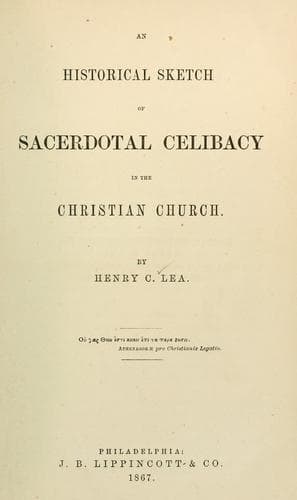
An Historical Sketch of Sacerdotal Celibacy in the Christian ChurchLea, Henry Charles
History
An Historical Sketch of Sacerdotal Celibacy in the Christian Church
Lea, Henry Charles
Catholic Church -- Clergy; Celibacy -- Catholic Church; Church history
wives was also required before married priests could be elevated to the
episcopate, and after consecration separation was strictly enjoined,
affording still further evidence of the laxity allowed to the other
grades. The iteration of the rules respecting _digami_ and marriage
with widows also indicates how difficult was the effort to resuscitate
those well-known regulations, although they were universally admitted
to be binding on all ecclesiastics.[592]
King Coloman, whose reign extended from 1095 to 1114, has the credit
of being the first who definitely enjoined immaculate purity on the
Hungarian priesthood. His laws, as collected by Alberic, have no
dates, and therefore we are unable to affix precise epochs to them;
but his legislation on the subject appears to have been progressive,
for we find edicts containing injunctions respecting _digami_ and
irregular unions in terms which indicate that single marriages were
not interfered with; and these may reasonably be deemed earlier than
other laws which formally prohibit the elevation to the diaconate of an
unmarried man without exacting from him a vow of continence, or of a
married man without the consent of his wife. The import of this latter
condition is explained by another law, which provided that no married
man should officiate at the altar unless his wife professed continence,
and was furnished by her husband with the means of dwelling apart from
him.[593] As these stringent regulations form part of the canons of a
council held by Archbishop Seraphin about the year 1109,[594] they were
probably borrowed from that council by Coloman, and incorporated into
his laws at a period somewhat later.
Public-domain text, read in full here on John Shaqi.
Reviews
Reviews
No reviews yet
Be the first to share your thoughts on this work.
Elsewhere in the archive
Join the Discussion
Join the discussion
Sign in to leave a comment or review.
Sign InorCreate an account