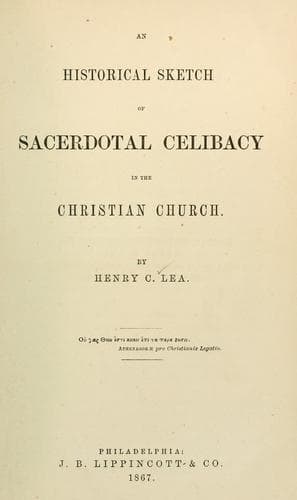
An Historical Sketch of Sacerdotal Celibacy in the Christian ChurchLea, Henry Charles
History
An Historical Sketch of Sacerdotal Celibacy in the Christian Church
Lea, Henry Charles
Catholic Church -- Clergy; Celibacy -- Catholic Church; Church history
The church of Sweden was no purer than its neighbors. That the rule
was recognized there at a tolerably early period is shown by the fact
that when the people of Scania, about the year 1180, revolted against
the exactions of Waldemar I. of Denmark, they demanded to be released
from the oppression of tithes and that the clergy should be married.
Singularly enough, the clerks stood by their bishop, Absalom, when he
laid an interdict on the province, and the arms of Waldemar speedily
subdued the revolt.[603] Not much, however, was gained for church
discipline by this. In 1204, the Archbishop of Lunden reported to
Innocent III. that he had used every endeavor to enforce the canons
and had brought many of his priests to observe chastity, but that
there still were many who persisted in retaining their women, whom
they treated as though they were legitimate wives, with fidelity and
conjugal affection. To this Innocent replied that the recalcitrants
must be coerced by suspension, and, if necessary, by deprivation of
benefice.[604] How little result this achieved is evident when we find
the archbishop again writing to Innocent III. complaining that the
Swedish priests persisted in living with their wives, and that they
moreover claimed to have a papal dispensation permitting it. Innocent,
in reply, cautiously abstained from pronouncing an opinion as to the
validity of these pretensions until he should have an opportunity of
examining the document to which they appealed.[605] The efforts at
this time were fruitless, for, in 1248, we find the Cardinal of St.
Sabina as legate of Innocent IV. holding a council at Schening, of
which the principal object was to reform these abuses, and so firmly
were they established, that the Swedes were considered as schismatics
of the Greek church, in consequence of the marriage of their priests.
The council supported by the royal power, succeeded in forcing the
Swedish ecclesiastics to give up their wives, by a liberal use of all
the punishments then in vogue, together with the significant threat of
abandoning them to the tender mercies of the secular tribunals.[606]
* * * * *
Public-domain text, read in full here on John Shaqi.
Reviews
Reviews
No reviews yet
Be the first to share your thoughts on this work.
Elsewhere in the archive
Join the Discussion
Join the discussion
Sign in to leave a comment or review.
Sign InorCreate an account