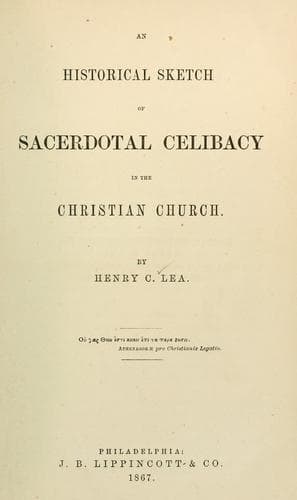
An Historical Sketch of Sacerdotal Celibacy in the Christian ChurchLea, Henry Charles
History
An Historical Sketch of Sacerdotal Celibacy in the Christian Church
Lea, Henry Charles
Catholic Church -- Clergy; Celibacy -- Catholic Church; Church history
In Denmark and along the northern coasts of Germany, there was equal
delay in enforcing the canon of celibacy. It is suggestive of some
powerful intercession in favor of the married clergy when we see
Paschal II., in 1117, writing to the King of Denmark that the rule
was imperative, and that he could admit of no exceptions to it.[607]
His insistence, however, was of little avail. In 1266, Cardinal
Guido, legate of Clement IV., held a council at Bremen, where he was
obliged to take rigorous measures to put an end to this Nicolitan
heresy. All married priests, deacons, and subdeacons were pronounced
incapable of holding any ecclesiastical office whatever. Children born
of such unions were declared infamous, and incapable of inheritance,
and any property received by gift or otherwise from their fathers
was confiscated. Those who permitted their daughters, sisters, or
other female relatives to contract such marriages, or gave them up in
concubinage to priests, were excluded from the church. That a previous
struggle had taken place on the subject is evident from the penalties
threatened against the prelates who were in the habit of deriving
a revenue from the protection of these irregularities, and from an
allusion to the armed resistance, made by the married and concubinary
priests with their friends, to all efforts to check their scandalous
conduct.[608]
In Friesland, too, the efforts of the sacerdotalists were long set at
naught. In 1219 Emo, Abbot of Wittewerum, describing the disastrous
inundations which afflicted his country, considers them as a punishment
sent to chastise the vices of the land, and among the disorders which
were peculiarly obnoxious to the wrath of God he enumerates the public
marriage of the priests, the hereditary transmission of benefices, and
the testamentary provision made by ecclesiastics for their children
out of the property which should accrue to the church; while his
references to the canon law inhibiting these practices, show that these
transgressions were not excusable through ignorance.[609] The warning
was unheeded, for Abbot Emo alludes incidentally, on various subsequent
occasions, to the hereditary transmission of several deaneries as a
matter of course.[610] The deans in Friesland were ecclesiastics of
high position, each having six or more parishes under his jurisdiction,
which he governed under legatine power from the Bishop of Munster.
When, in 1271, the people rose against them, exasperated by their
intolerable exactions, in some temporary truce the deans gave their
_children_ as hostages; and when, after their expulsion, Gerard of
Munster came to their assistance by excommunicating the rebels, the
latter defended the movement by the argument that the deans had
violated the laws of the church by handing down their positions from
father to son, and that each generation imitated the incontinence of
its predecessor.[611] Hildebrand might have applauded this reasoning,
but his days were past.
Public-domain text, read in full here on John Shaqi.
Reviews
Reviews
No reviews yet
Be the first to share your thoughts on this work.
Elsewhere in the archive
Join the Discussion
Join the discussion
Sign in to leave a comment or review.
Sign InorCreate an account