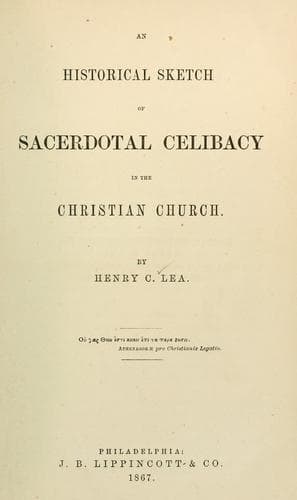
An Historical Sketch of Sacerdotal Celibacy in the Christian ChurchLea, Henry Charles
History
An Historical Sketch of Sacerdotal Celibacy in the Christian Church
Lea, Henry Charles
Catholic Church -- Clergy; Celibacy -- Catholic Church; Church history
The opposition of the clergy was not lessened by the manner in which
the secular authorities exercised the power bestowed upon them. Count
Robert saw the advantages derivable from the position of affairs and
seems to have been resolved to turn it thoroughly to account. Among
other modes adopted was that of the “jus spolii,” by which he seized
the effects of dying ecclesiastics, turning their families out of doors
and disinheriting the heirs. These arbitrary proceedings he defended on
the ground of the incontinence of the sufferers, boldly declaring that
wicked priests were no priests—as if, groaned the indignant clerks,
sinful men were not men.[628] In 1091, the Flemish priests complained
of these acts to Urban II., and he vainly endeavored to interfere in
their behalf.[629] Finding this resource fail, they appealed to their
metropolitan, Renaud, Archbishop of Rheims, who by active measures
succeeded in putting an end to the abuse in 1092.
Amid all this the church proved powerless to enforce its laws, and
again it called upon the feudal authority for assistance—this time in
a manner by which it admitted its impotence on a question so vital.
In 1099, Manasses of Rheims held a provincial synod at St. Omer,
which instructed the Count of Flanders, Robert the Hierosolymitan, to
seize the wives of all priests who after excommunication declined to
abandon their guilty partners; and in this he was not to ask or wait
for the assent of the bishop of the diocese. The sturdy Crusader would
doubtless have carried out this order to the letter, with all its
attendant cruelty and misery, but the clergy of the province united
in remonstrances so vehement that Manasses was forced to abandon his
position. He accordingly requested Robert on no account to disturb the
married priests and their wives, or to permit his nobles to do so,
except when assistance was demanded by the bishops. He acknowledged the
injustice he had committed in overslaughing the constituted authorities
of the church, and deprecated the rapine and spoliation which so
ill-advised a proceeding might cause. At the same time he admonished
his suffragans to proceed vigorously against all who married in orders,
and to call on the seigneurial power to coerce those who should prove
contumacious.[630]
Public-domain text, read in full here on John Shaqi.
Reviews
Reviews
No reviews yet
Be the first to share your thoughts on this work.
Elsewhere in the archive
Join the Discussion
Join the discussion
Sign in to leave a comment or review.
Sign InorCreate an account