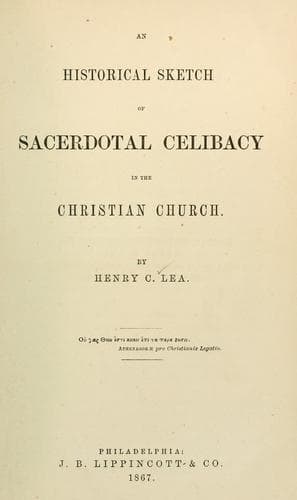
An Historical Sketch of Sacerdotal Celibacy in the Christian ChurchLea, Henry Charles
History
An Historical Sketch of Sacerdotal Celibacy in the Christian Church
Lea, Henry Charles
Catholic Church -- Clergy; Celibacy -- Catholic Church; Church history
All classes are described
as indulging in enormities hateful to God and man, and as having no
hesitation in setting the canons at defiance. In Britanny, as in
Wales and Spain, the centralizing influence of Rome was at fault, and
priestly marriage was persevered in long after it had been abrogated
elsewhere.[625]
* * * * *
In Flanders, Count Robert the Frisian and Adela, his mother, were well
disposed to second the reformatory measures of Gregory, but, doubting
their right to eject the offenders, they applied to him, in 1076, for
instructions. His answers were unequivocal, urging them to the most
prompt and summary proceedings.[626] The spirit in which the clergy
met the attack was manifested by the incident already described, when,
in 1077, an unfortunate zealot was burned at the stake in Cambrai for
maintaining the propriety of the papal decretals. The same disposition,
though fortunately leading to less deplorable results, was exhibited
in Artois. At the instance of Adela, Robert, in 1072, had founded
the Priory of Watten, near St. Omer. Despite this powerful interest
and patronage, the house had a severe struggle for existence, as
its prior, Otfrid, lent his influence to support the reform and to
enforce the decrees of Gregory. Reproaches and curses were showered
upon the infant community, and it was openly threatened with fire and
sword, until the unfortunate brethren felt equally insecure within
their walls and abroad. At length the Countess Adela took Otfrid
with her on a pilgrimage to Rome, and there the holy man procured
from Gregory a confirmation of the privileges of his house. On his
return, he found that this instrument only made the persecution more
vehement. Accusations of all kinds were made against the priory, and
its enemies succeeded in causing the brethren to be brought for trial
before the local synod, where the production of the papal charter was
ordered. It was at once pronounced a forgery, was taken away by force,
and was retained by the Bishop, Drogo of Terouane, in spite of all
remonstrance.[627]
Public-domain text, read in full here on John Shaqi.
Reviews
Reviews
No reviews yet
Be the first to share your thoughts on this work.
Elsewhere in the archive
Join the Discussion
Join the discussion
Sign in to leave a comment or review.
Sign InorCreate an account