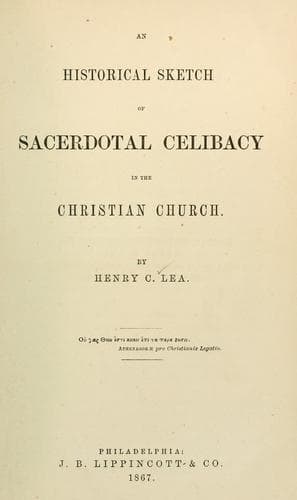
An Historical Sketch of Sacerdotal Celibacy in the Christian ChurchLea, Henry Charles
History
An Historical Sketch of Sacerdotal Celibacy in the Christian Church
Lea, Henry Charles
Catholic Church -- Clergy; Celibacy -- Catholic Church; Church history
The confusion which this attempted reformation caused in France was
apparently not so aggravated as we have seen it in Germany, and yet it
was sufficiently serious. Guibert de Nogent relates that in his youth
commenced the persecution of the married priests by Rome, when a cousin
of his, a layman of flagrant and excessive licentiousness, made himself
conspicuous by his attacks on the failings of the clergy. The family
were anxious to provide for young Guibert, who was destined to the
church, and the cousin used his influence with the patron of a benefice
to oust the married incumbent and bestow the preferment on Guibert.
The priest thus forcibly ejected abandoned neither his wife nor his
functions, but relieved his mind by excommunicating every day, in the
Mass, Guibert’s mother and all her family, until the good woman’s fears
were so excited that she abandoned the prebend which she had obtained
with so much labor.[633] We can readily conceive this incident to be
a type of what was occurring in every corner of the kingdom, when, in
an age of brute force, the reverence which was the only defence of the
priesthood was partially destroyed, and the people hardly knew whether
they were to adore their pastors as representatives of God or to dread
them as the powerful ministers of evil.
* * * * *
When the religious ardor of Europe rose to the wild excitement that
culminated in the Crusades, and Pope Urban II. astutely availed himself
of the movement to place the church in possession of a stronger
influence over the minds of men than it had ever before enjoyed, it
was to no purpose that the great council of Clermont, in 1095, took
the opportunity to proclaim in the most solemn manner the necessity
of perfect purity in ministers of the altar, to denounce irrevocable
expulsion for contravention of the rule, and to forbid the children of
ecclesiastics from entering the church except as monks or canons.[634]
It was the weightiest exposition of church discipline, and was
promulgated under circumstances to give it the widest publicity and the
highest authority. Yet, within a few years, we find Gualo, Bishop of
Paris, applying to Ivo of Chartres for advice as to what ought to be
done with a canon of his church who had recently married, and Ivo in
reply recommending as a safe course that the marriage be held valid,
but that the offender be relieved of his stipend and functions.[635]
His answer, moreover, is written in a singularly undecided tone, and
an elaborate argument is presented as though the matter were still
open to discussion, although Ivo’s laborious compilations of the canon
law show that he was thoroughly familiar with the ancient discipline
which the depravity of his generation had rendered obsolete.[636]
Hardly less significant is another epistle in which Ivo calls the
attention of Daimbert, Archbishop of Sens, to the conduct of one of his
dignitaries who publicly maintained two concubines and was preparing
Public-domain text, read in full here on John Shaqi.
Reviews
Reviews
No reviews yet
Be the first to share your thoughts on this work.
Elsewhere in the archive
Join the Discussion
Join the discussion
Sign in to leave a comment or review.
Sign InorCreate an account