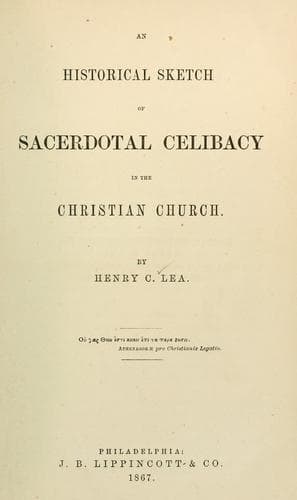
An Historical Sketch of Sacerdotal Celibacy in the Christian ChurchLea, Henry Charles
History
An Historical Sketch of Sacerdotal Celibacy in the Christian Church
Lea, Henry Charles
Catholic Church -- Clergy; Celibacy -- Catholic Church; Church history
to marry a third. He urges Daimbert to put an end to the scandal, and
suggests that if he is unable to accomplish it single-handed, he should
summon two or three of his suffragans to his assistance.[637] Either
of these instances is a sufficient confession of the utter futility of
the ceaseless exertions which for half a century the church had been
making to enforce her discipline. Nor, perhaps, can her ill-success
be wondered at when we consider how unworthy were the hands to which
was frequently intrusted the administering of the law and the laxity
of opinion which viewed the worst transgressions with indulgence. The
archdeacons were the officials to whom was specially confided the
supervision over sacerdotal morals, and yet, when a man occupying that
responsible position, like Aldebert of Le Mans, publicly surrounded
himself with a harem, and took no shame from the resulting crowd of
offspring, so little did his conduct shock the sensibilities of the age
that he was elevated to the episcopal chair, and only the stern voice
of Ivo could be heard reproving the measureless scandal.[638]
* * * * *
Equal looseness pervaded the monastic establishments. Hildebert, Bishop
of Le Mans, made numerous fruitless attempts to restore discipline
in the celebrated abbey of Euron, the monks of which indulged in the
grossest licentiousness, and successfully defied his power until he was
obliged to appeal to the papal legate for assistance.[639] Albero of
Verdun, after fruitless attempts to reform the monastery of St. Paul,
in his episcopal city, was obliged to turn out the monks by force and
replace them with Premonstratensians, who were then in the full ardor
of their new discipline.[640] The description which Ivo of Chartres
gives of the convent of St. Fara shows a promiscuous and shameless
prostitution, on the part of the nuns of that institution, even more
degrading.[641] Instances like these could be almost indefinitely
multiplied, such as that of St. Mary of Argentueil, reformed by
Heloise, the great foundation of St. Denis, previous to the abbacy of
Suger, and that of St. Gildas de Ruys in Britanny, as described by
Abelard;[642] who, moreover, depicts the nuns of the period, in general
terms, as abandoned to the most hideous licentiousness—those who were
good-looking prostituting themselves for hire, those who were not so
fortunate hiring men to gratify their passions, while the older ones,
who had passed the age of lust, acted as procuresses.[643] Innocent
III. may therefore be absolved from the charge of exaggeration when,
in ordering the reform of the nuns of St. Agatha, he alludes to their
convent as a brothel which infected with its evil reputation the whole
country around it.[644] A contemporary chronicler records as a matter
of special wonder that John of Salisbury, Bishop of Chartres, forced
his canons to live in cloisters according to the Rule of St. Augustin;
Public-domain text, read in full here on John Shaqi.
Reviews
Reviews
No reviews yet
Be the first to share your thoughts on this work.
Elsewhere in the archive
Join the Discussion
Join the discussion
Sign in to leave a comment or review.
Sign InorCreate an account