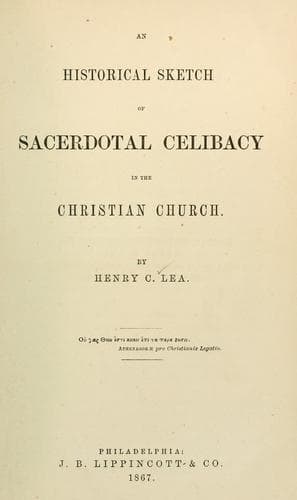
An Historical Sketch of Sacerdotal Celibacy in the Christian ChurchLea, Henry Charles
History
An Historical Sketch of Sacerdotal Celibacy in the Christian Church
Lea, Henry Charles
Catholic Church -- Clergy; Celibacy -- Catholic Church; Church history
Such was the condition of the Gallican church when, in 1119, Calixtus
II. stepped from the archiepiscopal see of Vienne to the chair of
St. Peter. His first great object was to end the quarrel with the
empire on the subject of investitures, the vicissitudes of which
rendered the papacy at the time of his accession an exile from Italy;
his second was to carry out the reforms so long and so fruitlessly
urged by his predecessors. To accomplish both these results he lost
no time in summoning a great council to assemble at Rheims, and when
it met in November, 1119, no less than fifteen archbishops, more
than two hundred bishops, and numerous abbots responded to the call,
representing Italy, France, Aquitaine, Spain, Germany, and England.
The attempted reconciliation with the Emperor Henry V. failed, but
the vices and corruptions of the church were vigorously attacked and
sternly prohibited for the future. All commerce with concubines or
wives was positively forbidden under pain of deprivation of benefice
and function. No choice was granted the offender, for continuance
in his sin after expulsion was punishable with excommunication; and
the hereditary transmission of ecclesiastical dignities and property
was strictly prohibited.[652] Whether it was the lofty character
of the new pope, his royal blood and French extraction, or whether
the solemnity of the occasion impressed men’s minds, it is not easy
now to guess, but unquestionably these proceedings produced greater
effect upon the Transalpine churches than any previous efforts of the
Holy See. Calixtus was long regarded as the real author of sacerdotal
celibacy in France, and his memory has been embalmed in the jingling
verses which express the dissatisfaction and spite of the clergy,
deprived of their ancestral privileges.
O bone Calliste, nunc clerus odit te;
Olim presbyteri poterant uxoribus uti;
Hoc detruxisti quando tu papa fuisti,
Ergo tuum festum nunquam celebratur honestum.[653]
Public-domain text, read in full here on John Shaqi.
Reviews
Reviews
No reviews yet
Be the first to share your thoughts on this work.
Elsewhere in the archive
Join the Discussion
Join the discussion
Sign in to leave a comment or review.
Sign InorCreate an account