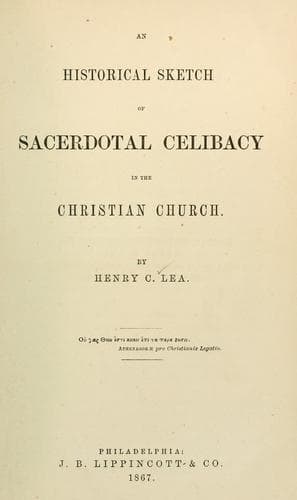
An Historical Sketch of Sacerdotal Celibacy in the Christian ChurchLea, Henry Charles
History
An Historical Sketch of Sacerdotal Celibacy in the Christian Church
Lea, Henry Charles
Catholic Church -- Clergy; Celibacy -- Catholic Church; Church history
Calixtus was not a man to rest half way, nor was he content with an
empty promise of obedience. Under the pressure of his influence, the
French prelates found themselves obliged to take measures for the
vigorous enforcement of the canons. What those measures were, and the
disposition with which they were received, may be understood from the
resultant proceedings in Normandy. Geoffrey, Archbishop of Rouen, on
leaving the council of Rheims, promptly called a synod, which assembled
ere the month was out. The canon prohibiting female intercourse roused
abhorrence and resistance among his clergy, and they inveighed loudly
against the innovation. Geoffrey singled out one who rendered himself
particularly prominent in the tumult, and caused him to be seized and
cast into prison; then, leaving the church, he called in his guards,
whom, with acute anticipation of trouble, he had posted in readiness.
The rude soldiery fell upon the unarmed priests, some of whom promptly
escaped; the rest, grasping what weapons they could find, made a
gallant resistance, and succeeded in beating back the assailants. A mob
speedily collected, which took sides with the archbishop. Assisted by
this unexpected reinforcement, the guards again forced their way into
the church, where they beat and maltreated the unfortunate clerks to
their heart’s content; when, as the chronicler quaintly observes, the
synod broke up in confusion, and the members fled without awaiting the
archiepiscopal benediction.[654]
The immediate effect of the reformation thus inaugurated may perhaps
be judged with sufficient accuracy by the story of Abelard and
Heloise, which occurred about this period. That Abelard was a canon
when that immortal love arose, was not, in such a state of morals, any
impediment to the gratification of his passion, nor did it diminish
the satisfaction of the canon Fulbert at the marriage of his niece,
for such marriages, as yet, were valid by ecclesiastical law. In her
marvellous self-abnegation, however, Heloise recognized that while the
fact of his openly keeping a mistress, and acknowledging Astrolabius
as his illegitimate son, would be no bar to his preferment, and would
leave open to him a career equal to the wildest dreams of his ambition,
yet to admit that he had sanctified their love by marriage, and had
repaired, as far as possible, the wrong which he had committed,
would ruin his prospects forever. In a worldly point of view it was
better for him, as a churchman, to have the reputation of shameless
immorality than that of a loving and pious husband; and this was so
evidently a matter of course that she willingly sacrificed everything,
and practised every deceit, that he might be considered a reckless
libertine, who had refused her the only reparation in his power. Such
was the standard of morals created by the church, and such were the
conclusions inevitably drawn from them.
Public-domain text, read in full here on John Shaqi.
Reviews
Reviews
No reviews yet
Be the first to share your thoughts on this work.
Elsewhere in the archive
Join the Discussion
Join the discussion
Sign in to leave a comment or review.
Sign InorCreate an account