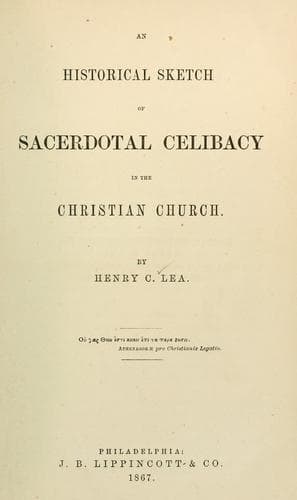
An Historical Sketch of Sacerdotal Celibacy in the Christian ChurchLea, Henry Charles
History
An Historical Sketch of Sacerdotal Celibacy in the Christian Church
Lea, Henry Charles
Catholic Church -- Clergy; Celibacy -- Catholic Church; Church history
That it was impossible to effect suddenly so great a change in the
habits and lives of the Anglican clergy was, indeed, admitted by
Paschal II. himself, when, in 1107, he wrote to Anselm concerning the
questions connected with the children of priests. While reminding him
of the rules of the church, he adds that as, in England, the larger and
better portion of the clergy fall within the scope of the prohibition,
he grants to the primate power of dispensation, by which, in view of
the sad necessity of the times, he can admit to the sacred offices
those born during their parents’ priesthood, who are fitted for it
by their education and purity of life. A second epistle on the same
subject attests the perplexity of the pope, recalling to Anselm’s
recollection his former injunctions, and recommending that, as there
was no personal guilt involved, those of the proscribed class who were
in orders should, if worthy of their positions, be allowed to retain
them, without the privilege of advancement.[675] The question, indeed,
was hotly debated. There is extant a letter written about this time by
Thibaut of Étampes, a dignitary of Oxford, to a certain Rosceline, who
with more zeal than discretion had promulgated the doctrine that the
sons of priests were canonically ineligible to ordination. Thibaut
characterizes this as not only an innovation, but a blasphemy, and
seems utterly unconscious that there was any authority for such a
rule.[676]
* * * * *
It may be remarked that thus far the proceedings of the reformers were
directed solely against the marriage of ecclesiastics. It may possibly
be that this arose from general conjugal virtue, and that, satisfied
with the privilege, no other disorders prevailed among the clergy; but
it is more probable that the heresy of marriage was so heinous in the
eyes of the sacerdotalists, that it rendered all other sins venial,
and that such other sins might be tacitly passed over in the endeavor
to put an end to the greater enormity. Be this as it may, the stubborn
wilfulness of the offenders only provoked increasing rigor on the part
of the authorities. We have seen that the council of 1102 produced
little result, and that when the secular power interfered to enforce
its canons, the church, jealous of its privileges, protested, so that
many priests retained their wives, and marriage was still openly
practised. King Henry, therefore, at length, in 1108, summoned another
council to assemble in London, where he urged the bishops to prosecute
the good work, and pledged his power to their support.[677] Fortified
by this and by the consent of the barons, they promulgated a series
of ten canons, whose stringent nature and liberal denunciation of
penalties prove that the prelates felt themselves strengthened by the
royal co-operation and thus able to compel obedience. The Nicene canon
was declared the unalterable law of the church; those ecclesiastics who
Public-domain text, read in full here on John Shaqi.
Reviews
Reviews
No reviews yet
Be the first to share your thoughts on this work.
Elsewhere in the archive
Join the Discussion
Join the discussion
Sign in to leave a comment or review.
Sign InorCreate an account