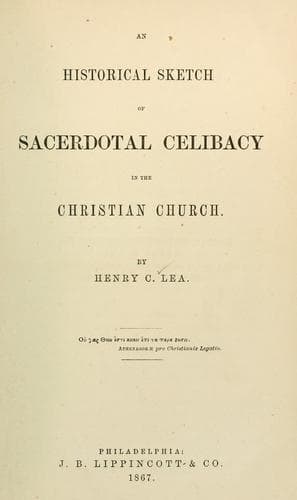
An Historical Sketch of Sacerdotal Celibacy in the Christian ChurchLea, Henry Charles
History
An Historical Sketch of Sacerdotal Celibacy in the Christian Church
Lea, Henry Charles
Catholic Church -- Clergy; Celibacy -- Catholic Church; Church history
had disregarded the decrees of the previous council were debarred from
performing their functions if longer contumacious; any priest requiring
to see his wife was only to do so in the open air and in the presence
of two legitimate witnesses; accusations of guilt were to be met by
regular canonical purgation, a priest requiring six compurgators, a
deacon four, and a subdeacon two, each of his own order. Disobedience
to these canons was declared punishable with deprivation of function
and benefice, expulsion from the church, and infamy. Only eight days of
grace were allowed; further persistence in wrong-doing being visited
with instant excommunication, and confiscation to the bishops of the
private property of the transgressors and of their women, together
with the persons of the latter. A very significant clause, moreover,
shows that grasping officials had discovered the speculative value
of previous injunctions, and that the degrading custom of selling
indulgence was already in common use, for the council required of all
archdeacons and deans, under penalty of forfeiture, an oath that they
would not receive money for conniving at infractions of the rule, nor
permit priests who kept women to celebrate mass or to employ vicars to
officiate for them.[678]
From the account of the historian, we may assume these to be rather
acts of parliament than canons of a council, and that the assembly was
convened for the special purpose of devising measures for subduing the
recalcitrant clergy. The temporal power was thus pledged to enforce
the regulations, and as so enterprising and resolute a monarch as
Henry had undertaken the reform, there can be little doubt that he
prosecuted it with vigor. Anselm died in 1109, and the clergy rejoiced
in the hope that their persecution would cease with the removal of
their persecutor, but the king proceeded to enforce the regulations
of the council of London with more vigor than ever, and soon obtained
at least an outward show of obedience. Eadmer darkly intimates that
this resulted in a great increase of shocking crimes committed with
those relatives whose residence was allowed, and he is at some pains to
argue that Anselm and his attempted reforms were not responsible for an
effect so little contemplated in their well-meant endeavors. Finally,
the ardor of the king cooled off; ecclesiastical officials were found
readily accessible to bribes for permitting female intercourse,
and those who had grown tired of the wives from whom they had been
separated found no difficulty in forming more desirable unions with new
ones. Eadmer sorrowfully adds that by this time there were few indeed
who continued to preserve the purity with which Anselm had labored so
strenuously to adorn his clergy.[679]
Public-domain text, read in full here on John Shaqi.
Reviews
Reviews
No reviews yet
Be the first to share your thoughts on this work.
Elsewhere in the archive
Join the Discussion
Join the discussion
Sign in to leave a comment or review.
Sign InorCreate an account