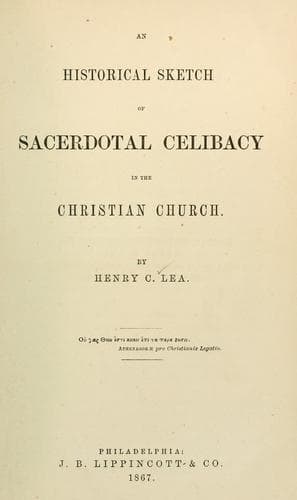
An Historical Sketch of Sacerdotal Celibacy in the Christian ChurchLea, Henry Charles
History
An Historical Sketch of Sacerdotal Celibacy in the Christian Church
Lea, Henry Charles
Catholic Church -- Clergy; Celibacy -- Catholic Church; Church history
reversion of his benefice to his son Nicholas, and applied to the
patron of his church, Martin, Abbot of Battle Abbey, who agreed to
conform to his wishes on condition that the annual payment exacted
from the church in question should be increased from ten shillings to
forty. Witgar agreed, and on an appointed day, accompanied by his son,
he met the abbot and his attendants at Colchester, where oaths were
publicly interchanged and a formal agreement was entered into.[692]
* * * * *
The efforts of Alexander and his successors were seconded by frequent
national and local synods, to whose special injunctions it is scarcely
worth while to refer in full. One noticeable point about them, however,
is that the term “wife” disappears, and is replaced by “concubina” or
“focaria”—the latter meaning a person who was a permanent occupant
of the priest’s hearth, but was not recognized by the authorities as
a lawful wife. Deans and archdeacons were enjoined to hunt up these
illegal companions, but from the frequency of the injunctions, we may
safely conclude that the search was not often successful, and that
the officials found the duty assigned to them too difficult or too
unprofitable for execution. That it was not impossible, however, when
earnestly undertaken, is shown by the readiness with which King John
unearthed the unfortunate creatures when it suited his policy to do
so. During the long dispute over the election of Giraldus Cambrensis
to the see of St. David’s, the king, who was resolved that no Welshman
should hold that preferment, instructed his officers, in 1202, to seize
the women of all the cathedral chapter who persisted in supporting
Giraldus.[693] The measure was doubtless an efficacious one, and he
repeated it when, in 1208, he persecuted the clergy in his blind
impotence of wrath at the interdict set upon his kingdom by Innocent
III. Discerning in these quasi-conjugal relations the tenderest spot in
which to strike those who had rebelled against his authority by obeying
the interdict, and at the same time as the surest and readiest means of
extorting money, among his other schemes of spoliation he caused all
these women to be seized, and then forced the unfortunate churchmen to
buy their partners back at exorbitant prices.[694]
The ease, indeed, with which the eyes of the officials were blinded
to that which was patent to the public was the subject of constantly
recurring legislation, the reiteration and increasing violence of
which bears irrefragable testimony at once to its necessity and its
impotence. Not only in grave synods and pastorals was the abuse
reprehended and deplored, but it offered too favorable a subject for
popular animadversion to escape the shafts of satire. In the preceding
century, Thomas à Becket, in a vehement attack upon simony, includes
this among the many manifestations of that multiform sin—
Public-domain text, read in full here on John Shaqi.
Reviews
Reviews
No reviews yet
Be the first to share your thoughts on this work.
Elsewhere in the archive
Join the Discussion
Join the discussion
Sign in to leave a comment or review.
Sign InorCreate an account