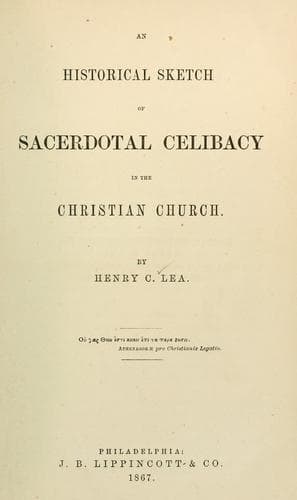
An Historical Sketch of Sacerdotal Celibacy in the Christian ChurchLea, Henry Charles
History
An Historical Sketch of Sacerdotal Celibacy in the Christian Church
Lea, Henry Charles
Catholic Church -- Clergy; Celibacy -- Catholic Church; Church history
What was the condition of the church resulting from these prolonged
and persistent efforts may be guessed from one or two examples. When,
in 1139, Nigel, Bishop of Ely, revolted against King Stephen, he
intrusted the defence of his castle of Devizes to his concubine, Maud
of Ramsbury. She bravely fulfilled her charge and repulsed the assaults
of the king, until he bethought him of a way to compel a surrender.
Obtaining possession of Roger, son of Maud and Nigel, the unhappy youth
was brought before the walls, and preparations were made to hang him in
his mother’s sight. At this her courage gave way, and she capitulated
at once.[687] Though the monkish chronicler stigmatizes Maud as “pellex
episcopi,” she may probably have been his wife—in either case the
publicity of the connection is a sufficient commentary on the morals
and manners of the age which took no exception to the elevation of
Richard Fitz-Neal, another son of the same reverend prelate, to the
bishopric of London and to the post of treasurer to King Henry II.
If this be attributed to the unbridled turbulence of Stephen’s reign,
we may turn to the comparatively calmer times of Henry II., when
Alexander III., amid his ceaseless efforts to restore the church
discipline of England, in 1171, ordered the Bishops of Exeter and
Worcester and the Abbot of Feversham to examine and report as to
the evil reputation of Clarembald, abbot-elect of St. Augustine’s
of Canterbury. In the execution of this duty they found that that
venerable patriarch had seventeen bastards in one village; purity
he ridiculed as an impossibility, while even licentiousness had no
attraction for his exhausted senses unless spiced with the zest
of publicity.[688] That a man whose profligacy was so openly and
shamelessly defiant could be elected to the highest place in the
oldest and most honored religious community in England is a fact which
lends color to the assertion of a writer of the time of King John,
that clergy and laity were indistinguishably bad,[689] and perhaps
justifies the anecdote told of Hugh, Bishop of Lincoln, who assumed
that the clergy were much worse than the laity.[690] How little these
scandals shocked the public is shown by the fact that it required papal
interference to cause the reformation of the nunnery of Avesbury.
The abbess had borne three children and the nuns, as the chronicler
informs us, were worse than their superior, but when Alexander forced
an investigation no canonical punishment was inflicted on the guilty.
Such of the nuns as promised to live chastely in future were allowed
to remain, and the rest were simply dismissed, while the abbess was
pensioned liberally with ten marks a year to preserve her from disgrace
and want. The vacancies thus created were filled with nuns from
Fontevraud, who proved to be as bad as those whom they replaced.[691]
The same insensibility is manifested in a legal transaction of the
period, when Witgar, the priest of Mendlesham, desired to secure the
Public-domain text, read in full here on John Shaqi.
Reviews
Reviews
No reviews yet
Be the first to share your thoughts on this work.
Elsewhere in the archive
Join the Discussion
Join the discussion
Sign in to leave a comment or review.
Sign InorCreate an account