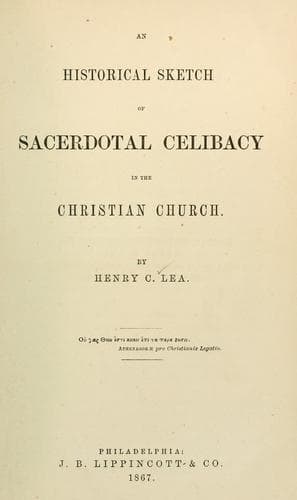
An Historical Sketch of Sacerdotal Celibacy in the Christian ChurchLea, Henry Charles
History
An Historical Sketch of Sacerdotal Celibacy in the Christian Church
Lea, Henry Charles
Catholic Church -- Clergy; Celibacy -- Catholic Church; Church history
Nor were the Anglican bishops remiss in seconding the efforts of the
pope to break down the opposition which thus openly defied their
power and ventured even to justify the heresy of sacerdotal marriage.
Councils were held which passed canons more stringent than ever;
bishops issued constitutions and pastorals denouncing the custom;
inquests were organized to traverse the dioceses and investigate
the household of every priest. The women especially were attacked.
Christian sepulture was denied them; property left to them and their
children by their partners in guilt was confiscated to the bishops;
churching after childbirth was interdicted to them; and, if still
contumacious after a due series of warnings, they were to be handed
over to the secular arm for condign punishment.[704] How much all this
bustling legislation effected is best shown by the declaration of the
legate, Cardinal Otto, in 1237, at the great council of London. He
deplores the fact that married men received orders and held benefices
while still retaining their wives, and did not hesitate to acknowledge
their children as legitimate by public deeds and witnesses. After
descanting upon the evils of this neglect of discipline, he orders that
all married clerks shall be deprived of preferment and benefice, that
their property shall not descend to wife or children, but to their
churches, and that their sons shall be incapable of holy orders unless
specially dispensed for eminent merit; then turning upon concubinary
priests, he inveighs strongly against their licentiousness, and decrees
that all guilty of the sin shall within thirty days dismiss their women
forever, under pain of suspension from function and benefice until full
satisfaction, persistent contumacy being visited with deprivation. The
archbishops and bishops are commanded to make thorough inquisition
throughout all the deaneries, to bring offenders to light, and also to
put an end to the iniquitous practice of ordaining the offspring of
such connections as successors in their father’s benefices.[705]
This legislation produced much excitement, and the legate even had
fears for his life. Some prelates, indeed, maintained that it only
was binding on the church of England during the residence of Otto,
but they were overruled, and it remained at least nominally in force
and was frequently referred to subsequently as the recognized law in
such matters. Its effect was considerable, and some of the bishops
endeavored to carry out its provisions with energy, as may be presumed
from a constitution of William of Cantilupe, Bishop of Worcester,
issued in 1240, ordering his officials to investigate diligently
whether any of the clergy of the diocese had concubines or were
married.[706]
Public-domain text, read in full here on John Shaqi.
Reviews
Reviews
No reviews yet
Be the first to share your thoughts on this work.
Elsewhere in the archive
Join the Discussion
Join the discussion
Sign in to leave a comment or review.
Sign InorCreate an account