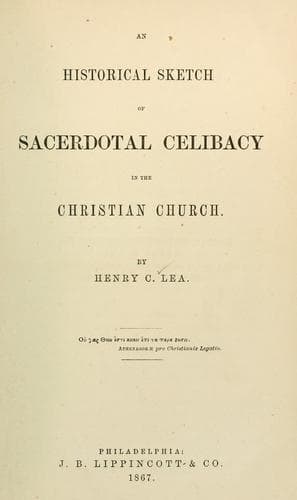
An Historical Sketch of Sacerdotal Celibacy in the Christian ChurchLea, Henry Charles
History
An Historical Sketch of Sacerdotal Celibacy in the Christian Church
Lea, Henry Charles
Catholic Church -- Clergy; Celibacy -- Catholic Church; Church history
To this period and to the disturbance caused by these proceedings are
doubtless to be attributed several satirical pieces of verse describing
the excitement occurring among the unfortunate clerks thus attacked in
their tenderest spot. The opening lines of one of these poems indicate
the novelty and unexpectedness of the new regulations:—
Rumor novus Angliæ partes pergiravit,
Clericos, presbyteros omnes excitavit,
* * * * *
Nascitur presbyteris hinc fera procella:
Quisquis timet graviter pro sua puella.
The author then describes a great council, attended by more than ten
thousand ecclesiastics, assembled to deliberate on the course to be
pursued in so delicate a conjuncture. An old priest commences—
Pro nostris uxoribus sumus congregati;
Videatis provide quod sitis parati,
Ad mandatum domini papæ vel legati,
Respondere graviter ne sitis dampnati.[707]
Another poem of similar character describes a chapter held by all
orders and grades to consider the same question. The various speakers
declare their inability to obey the new rule, except two, whose age
renders them indifferent. A learned doctor exclaims—
Omnis debet clericus habere concubinam;
Hoc dixit qui coronam gerit auro trinam:
Hanc igitur retinere decet disciplinam.
The general belief in the legality of the connection is shown by the
remark of another—
Surgens unus presbyter turba de totali ...
“Unam” dixit “teneo amore legali,
Quam nolo dimittere pro lege tali.”
Another expects to escape by paying his “cullagium”—
Duodecimus clamat magno cum clamore:
“Non me pontifex terret minis et pavore:
Sed ego nummos præbeam pro Dei amore,
Ut in pace maneam cara cum uxore.”
Another urges the indiscriminate immorality attending upon the attempt
to enforce an impossible asceticism—
Addidit ulterius: “Sitis memor horum,
Si vetare præsul vult specialem torum,
Cernet totum brevi plenum esse chorum
Ordine sacrorum adulterorum.”
And at length the discussion closes with the speech of a Dominican, who
ends his remarks by predicting—
Habebimus clerici duas concubinas:
Monachi, canonici totidem vel trinas:
Decani, prælati, quatuor vel quinas:
Sic tandem leges implebimus divinas.[708]
Public-domain text, read in full here on John Shaqi.
Reviews
Reviews
No reviews yet
Be the first to share your thoughts on this work.
Elsewhere in the archive
Join the Discussion
Join the discussion
Sign in to leave a comment or review.
Sign InorCreate an account