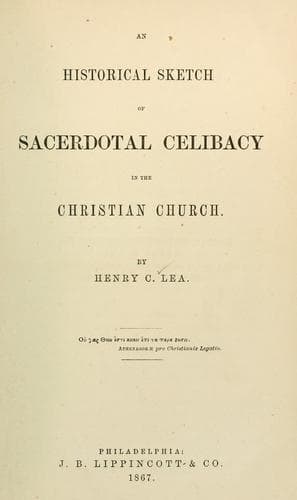
An Historical Sketch of Sacerdotal Celibacy in the Christian ChurchLea, Henry Charles
History
An Historical Sketch of Sacerdotal Celibacy in the Christian Church
Lea, Henry Charles
Catholic Church -- Clergy; Celibacy -- Catholic Church; Church history
In Scotland, the Christianity introduced by St. Columba had fallen
into the hands of the Culdees. These were originally monks of a more
than ordinary strictness of discipline, to whom the earliest recorded
allusion occurs in Ireland towards the close of the eighth century—the
name, Céle-dé (Keledeus, or Servus Dei) meaning simply Servant of
God. In the course of time the Culdees had so relaxed their rule that
they reappear in the eleventh century as an order nominally of monks,
yet fulfilling the functions of the secular clergy, and enjoying free
permission to marry, only abstaining from their wives when employed in
the actual ministry of the altar. With marriage had come the hereditary
transmission of the endowments of the church to their children, so that
the ancient abbeys and churches were well-nigh stripped of all their
possessions, and the distinction between clergy and laity was rather in
term than in fact. It may please the poet to construct a world of his
own, peopled by imaginary beings of angelic purity—
Peace to their shades! The pure Culdees
Were Albyn’s earliest priests of God,
Ere yet an island of her seas
By foot of Saxon monk was trod,
Long ere her churchmen by bigotry
Were barred from wedlock’s holy tie.
’Twas then that Aodh, famed afar,
In Iona preached the word with power,
And Reullura, beauty’s star,
Was the partner of his bower—
but in sober truth the Culdees were pure as long as they kept the
tradition of their founder, and it was not until they sank to a level
with their savage compatriots that they transgressed the rule and
became worldly and corrupt.[743] In 1125 the Cardinal-legate, John
of Crema, whose unlucky adventure in London has been already alluded
to, visited Scotland in the execution of his reformatory mission.
There he found on the throne David I., a prince whose life was devoted
to rescuing his subjects from their primæval barbarism. We know few
details of the history of those times, but it is fair to conjecture
that the exhortations of the legate had a share in arousing David to
a realization of the deficiencies and the corruptions of the Scottish
church, and in guiding him to the course which he adopted in its
reformation. After some fruitless efforts to restore the order of
Culdees to its original condition, he resolved on the sweeping measure
of removing all who should prove incorrigible. They were accordingly
turned out bodily from their establishments, such property as could be
traced was restored, and donations on an extended scale were made both
to the old foundations and to the new ones which the royal reformer
established—donations which gained for him, from an ungodly descendant,
the appellation of “Ane soir sanct for the crown.” These foundations
were then filled with regular clergy, brought from France and
England—chiefly canons of the order of St. Augustin—and the unfortunate
Culdees were turned adrift unless they would promise to observe the
Public-domain text, read in full here on John Shaqi.
Reviews
Reviews
No reviews yet
Be the first to share your thoughts on this work.
Elsewhere in the archive
Join the Discussion
Join the discussion
Sign in to leave a comment or review.
Sign InorCreate an account