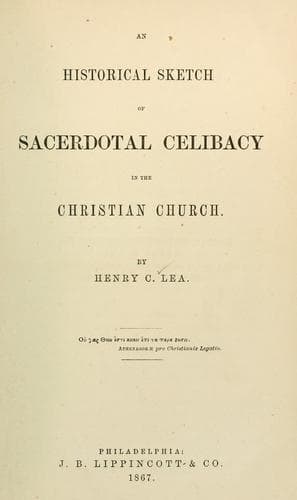
An Historical Sketch of Sacerdotal Celibacy in the Christian ChurchLea, Henry Charles
History
An Historical Sketch of Sacerdotal Celibacy in the Christian Church
Lea, Henry Charles
Catholic Church -- Clergy; Celibacy -- Catholic Church; Church history
for at the council of Cashel in 1171 we find an effort made to enforce
Christian marriage among the people, who are still described as
indulging in unrestricted polygamy and disregarding the nearest ties of
consanguinity.[736]
When about this period the English commenced the conquest which was
to lead to five centuries of cruel anarchy, they of course carried
with them their civil and ecclesiastical institutions. The original
conquerors—the Butlers, the Clares, and the Fitzgeralds—speedily
became incorporated with the native race, and were as Irish as the
O’Briens and the McCauras. Although the royal authority was limited
practically to the confines of the Pale, and embraced little beyond the
Ostman ports, yet it is easy to understand that the clerical license
habitual to the English spread beyond the political boundaries, and
the monastic spirit of the Hibernians was grievously wounded by the
unchastity which was disseminated like a contagion from the dissolute
priests who followed in the wake of Strong-bow and Prince John.[737]
Not twenty years after the first invasion, a council, summoned in 1186
by John in Dublin, was troubled by a quarrel between the Saxon priests
of Wexford, who mutually accused each other of publicly marrying and
keeping wives. This being duly proved, they were promptly degraded, to
the intense satisfaction of the Irish clergy, triumphant in their own
comparative purity of morals.[738] When, therefore, in 1205, Innocent
III. specially ordered his legate, Cardinal Julian, to put an end to
the hereditary transmission of benefices common in Ireland, the abuse
to which he referred was probably confined to the English Pale.[739]
The church establishments, in fact, were distinct, and consequently
when an Irish synod was held in Dublin, in 1217, its canons cannot be
considered as having authority beyond the narrow territory through
which the king’s writ would likewise run. Those canons show us that
the morality of the Saxon priesthood had not improved by the example
made of the priests of Wexford. The denunciations of concubinage
indicate the prevalence of that vice, and the severities threatened
against the unfortunate women contrast strangely with the lenity shown
to their more guilty partners.[740] A century later, if we may believe
the declaration of the synod of Ossory in 1320, the evil continued to
flourish, open, avowed, and universal, resisting alike the authority
of the church and the efforts to repress it by severity.[741] Whether
the offenders dismissed their consorts after the thirty days’ grace
allowed by the synod may well be doubted. With the spread of English
domination, the purity of the native church disappeared, and so great
became the general disregard of the canons that shortly before the
Reformation it was not an unusual thing for Irish priests to be openly
married, nor do those who did so seem to have thereby forfeited the
esteem of their neighbors.[742]
* * * * *
Public-domain text, read in full here on John Shaqi.
Reviews
Reviews
No reviews yet
Be the first to share your thoughts on this work.
Elsewhere in the archive
Join the Discussion
Join the discussion
Sign in to leave a comment or review.
Sign InorCreate an account