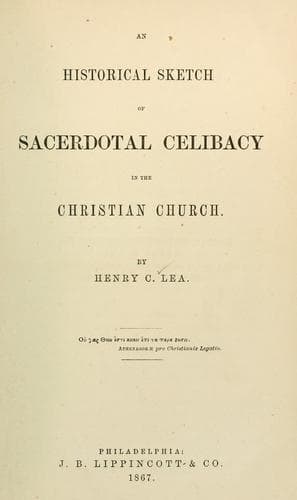
An Historical Sketch of Sacerdotal Celibacy in the Christian ChurchLea, Henry Charles
History
An Historical Sketch of Sacerdotal Celibacy in the Christian Church
Lea, Henry Charles
Catholic Church -- Clergy; Celibacy -- Catholic Church; Church history
abuse and insult, and was held up to popular derision in innumerable
lampoons.[757]
All of these efforts were nugatory. The Spaniards, engaged in an
interminable and often doubtful struggle with the Infidel, might well
claim consideration from the Holy Father, while the independent spirit
which they manifested in their resistance to the introduction of the
Roman ritual was a warning that it would be prudent not to proceed too
abruptly in the process of bringing them within the fold of St. Peter.
Whatever be the motives, indeed, which induced such strenuous apostles
of celibacy as Gregory, Urban, Paschal, and Calixtus to abstain from
urging upon them the reform which was so earnestly enforced elsewhere,
certain it is that little effort was made to deprive the Spanish clergy
of their wives. In all the epistles of the popes up to 1130 I can find
but one allusion to the subject, though communication between Spain
and Italy became daily more frequent, and the papal authority was
constantly exercised with greater decisiveness in the internal affairs
of the Spanish church.
When, in 1101, Diego Gelmirez succeeded in obtaining the see of
Compostella, Paschal II. addressed him an epistle, reproaching him
with the utter contempt of discipline in his diocese, and commanding
a reform. He chiefly complained of the incongruous common residence
of monks and nuns, which he severely condemned and peremptorily
prohibited, but he made some concession to the necessities of the time
in permitting the ordination of the sons of those priests who had,
“according to the ordinary custom of the country,” married prior to
the promulgation of what the pope significantly termed the Roman law;
and he carefully abstained from ordering a separation between them and
their wives, or even an enforcement of the canons for the future.[758]
Public-domain text, read in full here on John Shaqi.
Reviews
Reviews
No reviews yet
Be the first to share your thoughts on this work.
Elsewhere in the archive
Join the Discussion
Join the discussion
Sign in to leave a comment or review.
Sign InorCreate an account