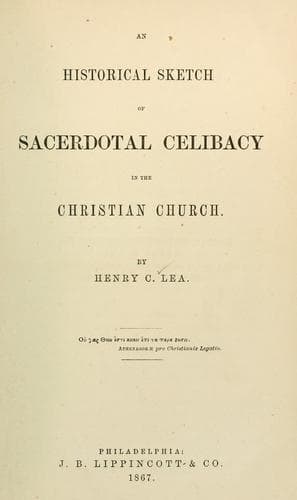
An Historical Sketch of Sacerdotal Celibacy in the Christian ChurchLea, Henry Charles
History
An Historical Sketch of Sacerdotal Celibacy in the Christian Church
Lea, Henry Charles
Catholic Church -- Clergy; Celibacy -- Catholic Church; Church history
Diego, who possessed no common measure of vigor and ambition, and who
needed the particular favor of the popes for the success of his plans
in elevating and aggrandizing his see, accordingly proceeded to reform
his clergy. There is extant a minute and circumstantial contemporary
history of his episcopate, written by his admiring disciples, who dwell
with much instance on his labors and success in reducing to discipline
the refractory canons of his cathedral seat; but in the numerous
allusions to these reforms there is no mention of the enforcement of
celibacy, while the fact that he would not allow them to minister at
the altar without canonical vestments is made the subject of repeated
gratulation and praise.[759] The absolute silence of the authors
with respect to the clergy at large shows that the reticence of Pope
Paschal was not misunderstood, and that there was no effort made to
bring the secular priesthood under subjection to the Roman discipline.
In the twenty-five canons of the council of Compostella in 1113 it
therefore need not surprise us that there is no reference whatever to
the subject, beyond an allusion to the children of ecclesiastics, whose
nurses were declared entitled to clerical privileges, thus giving them
a recognized and highly prized position.[760]
That Diego’s reforms, indeed, did not extend to the abrogation of
clerical marriage is evident from several incidental circumstances.
Thus, in 1114, the lords of the monastery of Botoa made it over to
the church of Santiago of Compostella, reserving to themselves their
life interest, with a reversion to any of their descendants who should
be ecclesiastics, and who might be willing to profess celibacy,
showing that the matter was optional with the secular clergy.[761]
That even the canons were bound by no absolute rules on the subject
is manifested by a very curious transaction which may be worth
recounting as illustrative in several aspects of the spirit of the
age. In 1127, Diego, at the head of his Gallician troops, accompanied
Alfonso VIII. on an expedition into Portugal. On their return, the army
halted at Compostella, where the archbishop received and entertained
his sovereign. They were bound by the closest ties, for Diego had
baptized, knighted, and crowned him, and had, moreover, constantly
stood his friend throughout his stormy youth, in the endless civil
wars which marked the disastrous reign of his mother, Queen Urraca.
Yet, prompted by evil counsellors who were jealous of Diego, the king
suddenly demanded of him an enormous sum of money, to pay off the army,
under threat of seizing and pillaging the city. After considerable
resistance, Diego was forced to submit, and to pay a thousand marks of
silver. He then sought a private interview, in which he solemnly and
affectionately warned Alfonso of the ruin of his soul which would ensue
if he did not undergo penance for thus impiously spoiling the Apostle
Santiago.
Public-domain text, read in full here on John Shaqi.
Reviews
Reviews
No reviews yet
Be the first to share your thoughts on this work.
Elsewhere in the archive
Join the Discussion
Join the discussion
Sign in to leave a comment or review.
Sign InorCreate an account