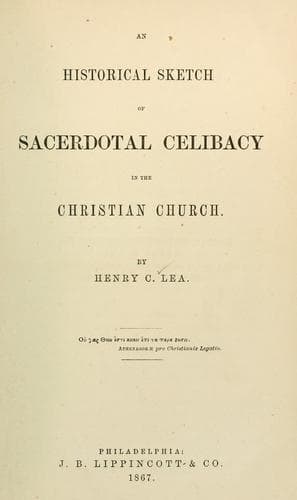
An Historical Sketch of Sacerdotal Celibacy in the Christian ChurchLea, Henry Charles
History
An Historical Sketch of Sacerdotal Celibacy in the Christian Church
Lea, Henry Charles
Catholic Church -- Clergy; Celibacy -- Catholic Church; Church history
Alexander did not confine himself to this portion of the question, but
with ceaseless activity labored to enforce the observance of celibacy
in general, and to repress the immorality which disgraced the church
throughout Christendom—immorality which led Alain de l’Isle, the
“Universal Doctor,” to characterize the ecclesiastics of his time as
being old men in their inefficiency and young men in their unbridled
passions.[805] Alexander’s efforts were particularly directed to put
an end to the practice of hereditary priesthood, and its constant
consequence, hereditary benefices. If I have made little allusion to
this subject during the century under consideration, it is not that the
church had relaxed her exertions to place some limit on this apparently
incurable disorder, or that the passive resistance to her efforts had
been less successful than we have seen it on previous occasions. The
perpetual injunctions of Alexander show at once the universality of
the vice, and the determination of the pontiff to eradicate it. At
the same time it became a frequent, and no doubt a profitable portion
of the duties of the papal chancery, to grant special dispensations
when those who held such preferment, or who desired to retain their
wives, underwent the dangers and expense of a journey to Rome, and
were rewarded for their confidence in the benignity of the Holy Father
by a rescript to their bishops, commanding their reinstatement in the
benefices from which they had been ejected.[806] The power to grant
such dispensations was shrewdly reserved as the exclusive privilege
of the papal court;[807] and a high churchman of the period assures
us that there was no difficulty in obtaining them.[808] It need not,
therefore, surprise us that Alexander’s successor, Lucius III., found
the hereditary transmission of the priestly office claimed as an
absolute right.[809] And not only did the claims of the papal chancery
thus interfere with the execution of the law by its power of granting
dispensations, but its appellate jurisdiction was constantly used to
avert punishment from the worst offenders. Thus Lucius III., about the
year 1181 was obliged to grant to Maurice de Sully, Bishop of Paris,
the right to dispossess of their benefices and functions, without
appeal, certain notorious concubinarians who, on being threatened with
the application of the law, had defied him by interposing an appeal to
Rome.[810] This centralization of all power in the papal court, and the
unblushing venality of the Roman officials, meet us in every age as
the efficient obstacle to the efforts of reforming prelates throughout
Europe.
Public-domain text, read in full here on John Shaqi.
Reviews
Reviews
No reviews yet
Be the first to share your thoughts on this work.
Elsewhere in the archive
Join the Discussion
Join the discussion
Sign in to leave a comment or review.
Sign InorCreate an account