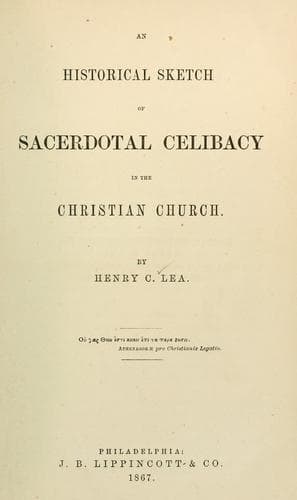
An Historical Sketch of Sacerdotal Celibacy in the Christian ChurchLea, Henry Charles
History
An Historical Sketch of Sacerdotal Celibacy in the Christian Church
Lea, Henry Charles
Catholic Church -- Clergy; Celibacy -- Catholic Church; Church history
Yet even Alexander was forced to abate somewhat of his stern
determination, in consideration of the incorrigible perversity of
the time, though he seems not to have remarked that he abandoned the
principle by admitting exceptions, and that the reasons assigned in
such individual cases might, with equal cogency, be applied to the
total withdrawal of the rule. When the Calabrian bishops informed
him that clerks in holy orders throughout their dioceses committed
matrimony, he ordered that priests and deacons should be irrevocably
separated from their wives; but, in the case of subdeacons of doubtful
morals, he instructed the prelates that they should tacitly connive at
the irregularity, lest in place of one woman, many should be abused,
and a greater evil be incurred, in the endeavor to avoid a less.[801]
This worldly wisdom also dictated his orders to the Bishop of Exeter,
in whose diocese subdeacons were in the habit of openly marrying. He
directs an examination into the lives and characters of the offenders;
those whose regular habits and staid morality afford fair expectation
of their chastity in celibacy are to be forcibly separated from their
wives; while those whose disorderly character renders probable their
general licentiousness if condemned to a single life are not to be
disturbed—taking care, however, that they do not minister at the altar,
or receive ecclesiastical benifices.[802]
Alexander adopted the principle that a simple vow of chastity did
not prevent marriage or render it null, but that a formal vow, or
the reception of orders, created a dissolution of marriage, or a
total inability to enter into it;[803] but Celestin III. carried the
principle still farther, and decreed that a simple vow, while it did
not dissolve an existing connection, was sufficient to prevent a future
one.[804]
Public-domain text, read in full here on John Shaqi.
Reviews
Reviews
No reviews yet
Be the first to share your thoughts on this work.
Elsewhere in the archive
Join the Discussion
Join the discussion
Sign in to leave a comment or review.
Sign InorCreate an account