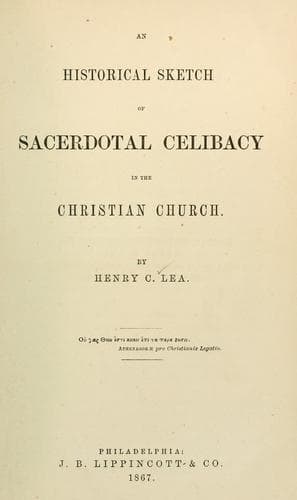
An Historical Sketch of Sacerdotal Celibacy in the Christian ChurchLea, Henry Charles
History
An Historical Sketch of Sacerdotal Celibacy in the Christian Church
Lea, Henry Charles
Catholic Church -- Clergy; Celibacy -- Catholic Church; Church history
These were but individual opinions. The policy of the church remained
unaltered, and Alexander’s successors emulated his example in
endeavoring to enforce the canons. Clement III. took advantage of the
profound impression which the capture of Jerusalem by Saladin (Oct.
1187) produced on all Europe, when the fall of the Latin kingdom
was attributed to the sins of Christendom. He preached a general
reformation. Abstinence from meat on Wednesdays and Saturdays for
five years, and various other kinds of mortification were enjoined
on all, to propitiate a justly offended Deity, but the clergy were
the objects of special reproof. Their extreme laxity of morals, their
neglect of the dress of their order, their worldly ambition and
pursuits, drinking, gambling, and flocking to tournaments, and the
unclerical deportment which left little difference between them and
the laity, were some of the accusations brought against them. To their
incontinence, however, was chiefly attributed the wrath of God, besides
the measureless scandals to which their conduct exposed the church, and
they were commanded to remove all suspected females from their houses
within forty days, under pain of suspension from their functions and
revenues.[817] That these rebukes were not the mere angry declamation
of an ascetic is shown by the declaration of Celestin III., a few years
later, that throughout Germany the custom still prevailed of fathers
substituting in their benefices their sons, born during priesthood, so
that frequently parent and offspring ministered together in the same
church;[818] and the extent of the demoralization is evident when we
find the sons of priests and deacons alluded to as a class ineligible
to knighthood in a constitution of Frederic Barbarossa in 1187.[819]
The regular clergy offered no exception to the general relaxation of
discipline. In 1192 Odo, Bishop of Toul, felt himself forced to deplore
the wickedness of monks who left their monasteries and publicly took to
themselves wives, but he could devise no better means of arresting the
scandal than excommunicating them and their growing families.[820]
Yet, with all his ardor, Clement admitted that celibacy was only
a local rule of discipline, and that there was nothing really
incompatible between marriage and the holy functions of the altar.
The time had not yet come when the council of Trent could erect the
inviolable continence of the priesthood into an article of faith, and
Clement was willing to allow that priests of the Greek church, under
his jurisdiction, could legitimately be married and could celebrate
mass while their families were increasing around them.[821]
* * * * *
Public-domain text, read in full here on John Shaqi.
Reviews
Reviews
No reviews yet
Be the first to share your thoughts on this work.
Elsewhere in the archive
Join the Discussion
Join the discussion
Sign in to leave a comment or review.
Sign InorCreate an account