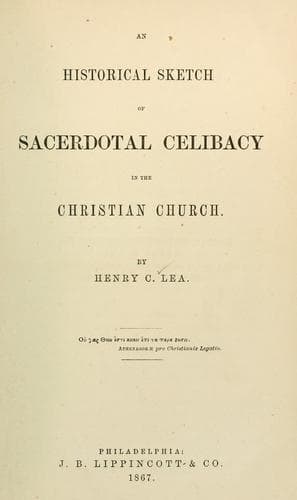
An Historical Sketch of Sacerdotal Celibacy in the Christian ChurchLea, Henry Charles
History
An Historical Sketch of Sacerdotal Celibacy in the Christian Church
Lea, Henry Charles
Catholic Church -- Clergy; Celibacy -- Catholic Church; Church history
Innocent III., who, by the fortunate conjunction of the time in which
he flourished with his own matchless force of character, enjoyed
perhaps the culmination of papal power and prerogative, at length
brought to the struggle an influence and a determination which could
scarcely fail to prove decisive on any question capable of a favorable
solution. By his decretals and his legates he labored assiduously to
enforce obedience to the canons, and when, in 1215, he summoned the
whole Christian world to meet in the fourth council of Lateran, that
august assembly of about thirteen hundred prelates, acting under his
impulsion, and reflecting his triumph over John of England and Otho of
Germany, spoke with an authority which no former body since that of
Nicæa had possessed. Its canons on the subject before us were simple,
perhaps less violent in their tone than those of former synods, but
they breathed the air of conscious strength, and there was no man that
dared openly to gainsay them. A more rigid observance of the rules was
enjoined, and any one officiating while suspended for contravention
was punishable with perpetual degradation and deprivation of his
emoluments. Yet the rule was admitted to be merely a local ordinance
peculiar to the Latin church, for, in the effort made by the council to
heal the schism with Constantinople, the right of the East to permit
the marriage of its priests was acknowledged by a clause visiting
with severer penalties those who by custom were allowed to marry, and
who, notwithstanding this license, still permitted themselves illicit
indulgences. The disgraceful traffic by which in some places prelates
regularly sold permissions to sin was denounced in the strongest terms,
as a vice equal in degree to that which it encouraged; and the common
custom of fathers obtaining preferment in their own churches for their
illegitimate offspring was reprobated as it deserved.[822]
There is nothing novel in these canons, nor can they in strictness be
said to constitute an epoch in the history of sacerdotal celibacy. They
enunciate no new principles, they threaten no new punishments, yet are
they noteworthy as marking the settled policy of the church at a period
when it had acquired that plenitude of power and vigor of organization
which insured at least an outward show of obedience to its commands.
The successive labors of so long a series of pontiffs, during more
than a century and a half, carrying with them the cumulative authority
of Rome, had gradually broken down resistance, and the Lateran canons
were the definitive expression of its discipline on this subject.
Accordingly, though we shall see how little was accomplished in
securing the purity of the priesthood, which was the ostensible object
of the rule, yet hereafter there are to be found few traces of marriage
in holy orders, except in the distant countries to which reference has
already been made.
Public-domain text, read in full here on John Shaqi.
Reviews
Reviews
No reviews yet
Be the first to share your thoughts on this work.
Elsewhere in the archive
Join the Discussion
Join the discussion
Sign in to leave a comment or review.
Sign InorCreate an account