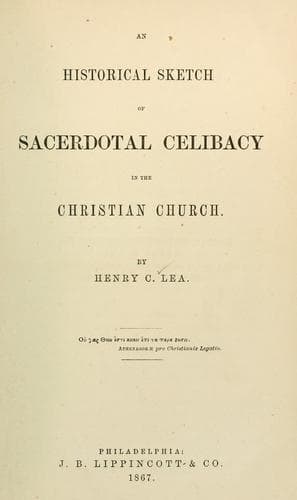
An Historical Sketch of Sacerdotal Celibacy in the Christian ChurchLea, Henry Charles
History
An Historical Sketch of Sacerdotal Celibacy in the Christian Church
Lea, Henry Charles
Catholic Church -- Clergy; Celibacy -- Catholic Church; Church history
It is somewhat significant that when, in France, the rule of celibacy
was completely restored, strict churchmen should have found it
necessary also to revive the hideously suggestive restriction which
denied to the priest the society of his mother or of his sister. Even
in the profoundest barbarism of the tenth century, or the unbridled
license of the eleventh; even when Damiani descanted upon the disorders
of his contemporaries with all the cynicism of the most exalted
asceticism, horrors such as these are not alluded to. It is reserved
for the advancement of the thirteenth century and the enforcement of
celibacy to show us how outraged human nature may revenge itself and
protest against the shackles imposed by zealous sacerdotalism or
unreasoning bigotry. In 1208, Cardinal Guala, Innocent’s legate in
France, issued an order in which he not only repeated the threadbare
prohibitions respecting focariæ and concubines, but commanded that
even mothers and other relatives should not be allowed to reside with
men in holy orders, the devil being the convenient personage on whom,
as usual, was thrown the responsibility of the scandals which were
known to occur frequently under such circumstances.[827] That this
decree was not allowed to pass into speedy oblivion is shown by a
reference to it as still well known and in force a century later, in
the statutes of the church of Tréguier.[828] And that the necessity
for it was not evanescent may be assumed from its repetition in the
regulations of the see of Nismes, the date of which is uncertain, but
probably attributable to the close of the fourteenth century.[829]
At the same time, we have evidence that Cardinal Guala’s efforts
were productive of little effect. Four years later, in 1212, we find
Innocent formally authorizing the prelates of France mercifully to
pardon those who had been excommunicated under Guala’s rules, with
the suggestive proviso that the power thus conferred was not to be
used for the purpose of extorting unhallowed gains.[830] Still more
significant is the fact that in the same year Innocent dispatched
another legate, Cardinal Robert, duly commissioned to renew the endless
task of purifying the Gallican church. Guala’s efforts would seem to
have already passed into oblivion, for in a council which Cardinal
Robert held in Paris, he gravely promulgated a canon forbidding the
priesthood from keeping their concubines so openly as to give rise to
scandal, and threatening the recalcitrants with excommunication if they
should persist in retaining their improper consorts for forty days
after receiving notice.[831] That monachism was no less productive of
sin in the depraved moral atmosphere of the age is rendered evident
by other canons of the same council, which prohibit both monks and
nuns from sleeping two in a bed, with the avowed object of repressing
crimes against nature.[832] It may well be asked what was the value of
Public-domain text, read in full here on John Shaqi.
Reviews
Reviews
No reviews yet
Be the first to share your thoughts on this work.
Elsewhere in the archive
Join the Discussion
Join the discussion
Sign in to leave a comment or review.
Sign InorCreate an account