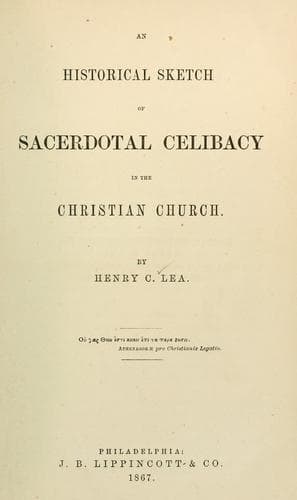
An Historical Sketch of Sacerdotal Celibacy in the Christian ChurchLea, Henry Charles
History
An Historical Sketch of Sacerdotal Celibacy in the Christian Church
Lea, Henry Charles
Catholic Church -- Clergy; Celibacy -- Catholic Church; Church history
the continence aimed at in monastic vows when the whole body of the
monastic orders was the subject of such degrading regulations as these.
The clergy of France were not exceptional, and, unfortunately,
there can be no denial of the fact that notorious and undisguised
illicit unions, or still more debasing secret licentiousness, was a
universal and pervading vice of the church throughout Christendom.
Its traces amid all the ecclesiastical legislation of the thirteenth,
fourteenth, and fifteenth centuries are too broad and deep to be
called into question, and if no evidence remained except the constant
and unavailing efforts to repress it, that alone would be sufficient.
National and local synods, pastoral epistles, statutes of churches,
all the records of ecclesiastical discipline are full of it. Now
deploring and now threatening, exhausting ingenuity in devising new
regulations and more effective punishments, the prelates of those
ages found themselves involved in a task as endless and as bootless
as that of the Danaidæ. Occasionally, indeed, it is lost sight of
momentarily, when the exactions and usurpations of the laity, or the
gradual extension of secular jurisdiction monopolized the attention
of those who were bound to defend the privileges of their class; but,
with these rare exceptions, it may be asserted as a general truth that
scarcely a synod met, or a body of laws was drawn up to govern some
local church, in which the subject did not receive a prominent position
and careful consideration. It would be wearisome and unprofitable to
recapitulate here the details of this fruitless iteration. Without by
any means exhausting the almost limitless materials for investigation,
I have collected a formidable mass of references upon the subject, but
an examination of them shows so little of novelty and so constant a
recurrence to the starting-point, that no new principles can be evolved
from them, and their only interest lies in their universality, and in
demonstrating how resultless was the unceasing effort to remove the
uneffaceable plague-spot.
Public-domain text, read in full here on John Shaqi.
Reviews
Reviews
No reviews yet
Be the first to share your thoughts on this work.
Elsewhere in the archive
Join the Discussion
Join the discussion
Sign in to leave a comment or review.
Sign InorCreate an account