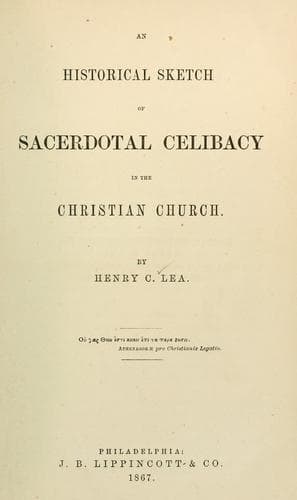
An Historical Sketch of Sacerdotal Celibacy in the Christian ChurchLea, Henry Charles
History
An Historical Sketch of Sacerdotal Celibacy in the Christian Church
Lea, Henry Charles
Catholic Church -- Clergy; Celibacy -- Catholic Church; Church history
In the confessed nullity of penal legislation it was natural for the
church to have recourse to her supernatural armory, and accordingly
we have ample store of legends framed with the hope of frightening
by spiritual terrors those who were indurated to canon and decretal.
The dead concubine of a priest was seen chased by infernal demons,
and a knight who sought to protect her had a handful of hair left in
his grasp by her mad terror; and the reality of the awful scene was
verified on opening her tomb and finding her tresses deficient. So
a nun who had yielded to temptation and had sought to conceal her
frailty by murdering her child, dying unconfessed, was seen wandering
hopelessly with a burning infant clasped to her bosom, which she
proclaimed was to be her torment throughout eternity.[836] It is no
wonder that the well-meant ingenuity which devised these tales met
with slender reward, and that the threat of post-mortem punishment
was as powerless as that of temporal penalties, for these tales were
counterbalanced by other superstitions, such as that which taught that
the most sinful, even among laymen, could obtain eternal salvation
by the simple expedient of enveloping himself in a monastic habit
on his death-bed. The Benedictines had well-authenticated cases in
plenty where the most vicious of men, by adopting this plan, were
rescued by St. Benedict himself from the hands of demons conducting
them to eternal punishment, in spite of Satan’s complaints that he
was defrauded of his rights.[837] The Franciscans contended with the
Benedictines as to the efficacy of their respective patrons, and
related with pride that St. Francis visited purgatory every year and
carried with him to heaven the souls of his followers—a general plan of
salvation which gave his vestments a decided superiority over those of
the older order. As the practice became more common, it was recognized
as equally dangerous to the welfare of the faithful and to the revenues
of the church, and was condemned as a pernicious error.[838]
* * * * *
So open and avowed was the shame of the church that the Neapolitan
code, promulgated about 1231 by the enlightened Frederic II.,
absolutely interfered to give a quasi legitimacy to the children of
ecclesiastics, and removed, to a certain extent, their disability of
inheritance. The imperial officials were ordered to assign appropriate
shares in parental estates to such children, notwithstanding their
illegitimacy, conditioned on the payment of an annual tax to the
imperial court; and parents were not allowed to alienate their
property to the prejudice of such children, any more than in cases of
the offspring of lawful wedlock.[839] The numbers and influence of
the class thus protected must indeed have been great to induce such
interference in their favor.
Public-domain text, read in full here on John Shaqi.
Reviews
Reviews
No reviews yet
Be the first to share your thoughts on this work.
Elsewhere in the archive
Join the Discussion
Join the discussion
Sign in to leave a comment or review.
Sign InorCreate an account