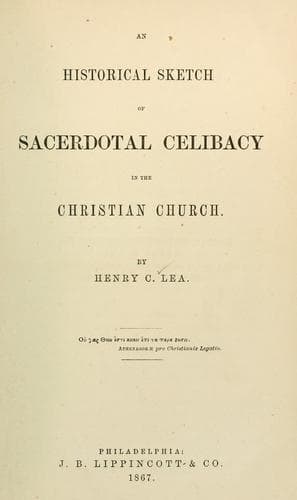
An Historical Sketch of Sacerdotal Celibacy in the Christian ChurchLea, Henry Charles
History
An Historical Sketch of Sacerdotal Celibacy in the Christian Church
Lea, Henry Charles
Catholic Church -- Clergy; Celibacy -- Catholic Church; Church history
We have already seen ecclesiastical authority for the assertion
that in the Spanish Peninsula the children sprung from such illicit
connections rivalled in numbers the offspring of the laity. That they
were numerous elsewhere may be presumed when we see Innocent IV.,
in 1248, forced to grant to the province of Livonia the privilege
of having them eligible to holy orders, except when born of parents
involved in monastic vows,[840] for necessity alone could excuse so
flagrant a departure from the canons enunciated during the preceding
two centuries. A similar conclusion is deducible from the fact that
in the municipal code in force throughout Northern Germany during the
thirteenth and fourteenth centuries, they were deemed of sufficient
importance to be entitled to a separate place in the classification of
wer-gilds, or blood-moneys; while the aim of the lawgiver to stigmatize
them is manifested by his placing them below the peasant, deeming them
superior only to the juggler;[841] and that this was not a provision
of transient force is clear from the commentary upon it in a body of
law dating from the end of the fourteenth century.[842] Nor is the
evidence less convincing which may be drawn from the use of the old
German word _pfaffenkind_, or priest’s son, which became generally used
as equivalent to bastard.[843] It would not, indeed, be difficult to
understand the numbers of this class of the population if ecclesiastics
in general followed the example of Henry III., Bishop of Liége, whose
natural children amounted to no less than sixty-five.[844]
The direct encouragement thus given to illicit connections, by
providing for the children sprung from them, neutralized one of the
principal modes by which the church endeavored to suppress them.
The innumerable canons issued during this period, forbidding and
pronouncing null and void all testamentary provisions in favor of
concubines and descendants, prove not only how much stress was laid
upon this as an efficient means of repression, but also how little
endeavor was made by the guilty parties to conceal their sin. As all
testaments came within the sphere of ecclesiastical jurisdiction, it
would seem that there should have been no difficulty in enforcing
regulations of this kind, yet their constant repetition proves either
that those who were intrusted with their execution were habitually
remiss, or else that the popular feelings were in favor of the
unfortunates, and interfered with the efficacy of the laws.
Public-domain text, read in full here on John Shaqi.
Reviews
Reviews
No reviews yet
Be the first to share your thoughts on this work.
Elsewhere in the archive
Join the Discussion
Join the discussion
Sign in to leave a comment or review.
Sign InorCreate an account