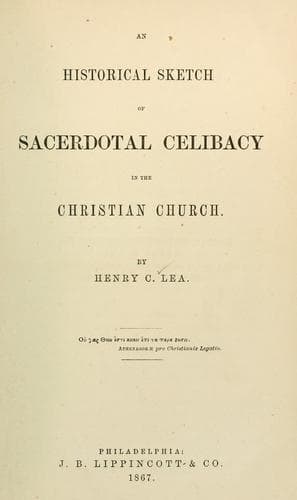
An Historical Sketch of Sacerdotal Celibacy in the Christian ChurchLea, Henry Charles
History
An Historical Sketch of Sacerdotal Celibacy in the Christian Church
Lea, Henry Charles
Catholic Church -- Clergy; Celibacy -- Catholic Church; Church history
venal influences at work in the Apostolic court. But the abuse was
too profitable to be suppressed, and it continued until after the
Reformation had shown the necessity of some decent reticence in the
exercise of powers no longer regarded as wholly irresponsible.
* * * * *
My object has been to consider the subject of ascetic celibacy as
a portion simply of ecclesiastical history, and yet I cannot well
conclude this section without a hasty glance at its influence on
society at large. That influence, as far as the secular clergy were
its instruments, was evidently one of almost unmixed evil. The parish
priest, if honestly ascetic, was thereby deprived of the wholesome
common bond of human affections and sympathies, and was rendered less
efficient for good in consoling the sorrows and aiding the struggles
of his flock. If, on the other hand, he was a hypocrite, or if he had
found too late that the burden he had assumed was too heavy for his
strength, the denial of the natural institution of marriage was the
source of immeasurable corruption to those intrusted to his charge,
who looked up to him not only as a spiritual director, but as a
superior being who could absolve them from sin, and whose partnership
in guilt was in itself an absolution.[870] That such was the condition
of innumerable parishes throughout Europe, there is unfortunately no
reason to doubt, and all of the severer churchmen of the period, in
attacking the vices of the clergy, give us to understand that either
their example led the laity into evil, or that their immorality
rendered it impossible for them to correct the vices of the flocks. As
Cæsarius of Heisterbach says, “Since the priesthood mostly lead evil
and incontinent lives, they soothe rather than excite the consciences
of the worldly.”[871] The incongruity of this may perhaps explain to
some extent the anomaly of the practical grossness of the Middle Ages,
combined with the theoretical ascetic purity which was held out as the
duty of every Christian who desired to be acceptable to his Creator.
Public-domain text, read in full here on John Shaqi.
Reviews
Reviews
No reviews yet
Be the first to share your thoughts on this work.
Elsewhere in the archive
Join the Discussion
Join the discussion
Sign in to leave a comment or review.
Sign InorCreate an account