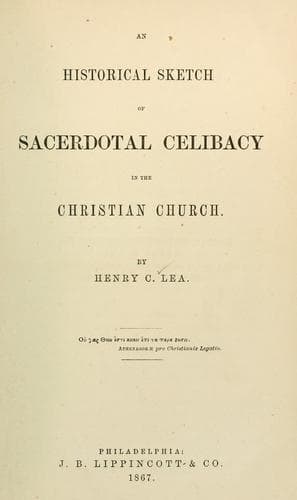
An Historical Sketch of Sacerdotal Celibacy in the Christian ChurchLea, Henry Charles
History
An Historical Sketch of Sacerdotal Celibacy in the Christian Church
Lea, Henry Charles
Catholic Church -- Clergy; Celibacy -- Catholic Church; Church history
the sensibilities of the age, that after his release from the prison to
which he had been consigned by the fathers of Constance, his successor,
Martin V. consoled him in his degradation by creating him Dean of the
Sacred College.
If the Councils of Constance and of Bâle worked some apparent reform
in the outward morality of the papacy, their effect soon passed away.
The latter half of the fifteenth century scarcely saw a supreme
pontiff without the visible evidences of human frailty around him, the
unblushing acknowledgment of which is the fittest commentary on the
tone of clerical morality. Sixtus IV. was believed to embody the utmost
possible concentration of human wickedness,[865] until Borgia came to
divide with him the preëminence of evil. The success of Innocent VIII.
in increasing the population of Rome was a favorite topic with the wits
of the day;[866] but the epitaph which declared that filth, gluttony,
avarice, and sloth lay buried in his tomb[867] did not anticipate the
immediate resurrection of the worst of those vices in the person of his
successor Alexander VI. If the crimes of Borgia were foul, their number
and historical importance have rendered them so well known that I may
be spared more than a passing allusion to a career which has made his
name synonymous with all that can degrade man to a level at once with
the demon and the brute.[868]
Such men as Alexander can hardly be deemed exceptional, save inasmuch
as brilliant talents and native force of character might enable them
to excel their contemporaries in guilt as in ambition. They were the
natural product of a system which for four centuries had bent the
unremitting energies of the church to securing temporal power and
wealth, with exemption from the duties and liabilities of the citizen.
Such were the fruits of the successful theocracy of Hildebrand, which,
intrusting irresponsible authority to fallible humanity, came to regard
ecclesiastical aggrandizement as a full atonement for all and every
crime. That the infection had spread even to the ultimate fibres of
the establishment can readily be believed, for the supremacy of the
Papal authority gave it the power of controlling the character of every
parish in Christendom. We shall see hereafter, as we have already seen,
how that power was habitually abused, and how the nullification of the
canons was a recognized source of income to the successor of St. Peter
and his needy officials. The evil was one that had long been recognized
and complained of since Hincmar of Rheims so emphatically denounced
it. St. Bernard declared that Rome was the acknowledged refuge of all
ambitious and licentious men who desired either promotion or to retain
the preferment which they had forfeited.[869] In the fiery zeal with
which he warns his protégé, Eugenius III., not to be deceived by such
suitors, he shows us how useless were local efforts at reformation
when they could be so readily set aside and rendered nugatory by the
Public-domain text, read in full here on John Shaqi.
Reviews
Reviews
No reviews yet
Be the first to share your thoughts on this work.
Elsewhere in the archive
Join the Discussion
Join the discussion
Sign in to leave a comment or review.
Sign InorCreate an account