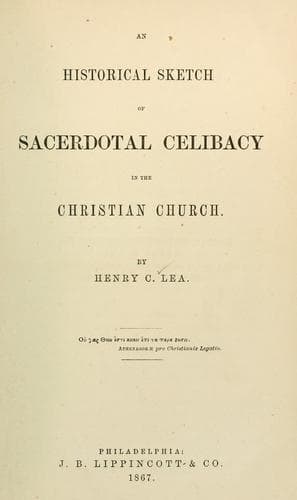
An Historical Sketch of Sacerdotal Celibacy in the Christian ChurchLea, Henry Charles
History
An Historical Sketch of Sacerdotal Celibacy in the Christian Church
Lea, Henry Charles
Catholic Church -- Clergy; Celibacy -- Catholic Church; Church history
There is no injustice in holding the church responsible for the
lax morality of the laity. It had assumed the right to regulate
the consciences of men and to make them account for every action
and even for every thought. When it promptly caused the burning of
those who ventured on any dissidence in doctrinal opinion or in
matters of pure speculation, it could not plead lack of authority to
control them in practical virtue. Its machinery was all-pervading,
and its power autocratic. It had taught that the priest was to be
venerated as the representative of God and that his commands were to
be implicitly obeyed. It had armed him with the fearful weapon of
the confessional, and by authorizing him to grant absolution and to
pronounce excommunication, it had delegated to him the keys of heaven
and hell. By removing him from the jurisdiction of the secular courts
it had proclaimed him as superior to all temporal authority. Through
ages of faith the populations had humbly received these teachings and
bowed to these assumptions, until they entered into the texture of the
daily life of every man. While thus grasping supremacy and using it to
the utmost possibility of worldly advantage, the church therefore could
not absolve itself from the responsibilities inseparably connected
with power, and chief among these responsibilities is to be numbered
the moral training of the nations thus subjected to its will. While
the corruption of the teachers thus had necessarily entailed the
corruption of the taught, it is not too much to say that the tireless
energy devoted to the acquisition and maintenance of power, privileges,
and wealth, if properly directed, under all the advantages of the
situation, would have sufficed to render mediæval society the purest
that the world has ever seen.
Public-domain text, read in full here on John Shaqi.
Reviews
Reviews
No reviews yet
Be the first to share your thoughts on this work.
Elsewhere in the archive
Join the Discussion
Join the discussion
Sign in to leave a comment or review.
Sign InorCreate an account