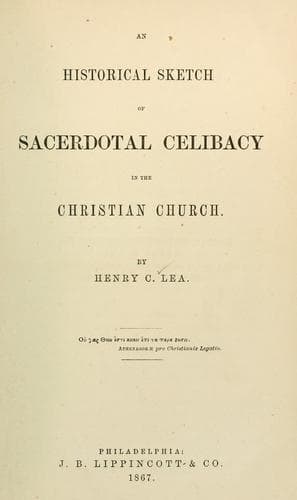
An Historical Sketch of Sacerdotal Celibacy in the Christian ChurchLea, Henry Charles
History
An Historical Sketch of Sacerdotal Celibacy in the Christian Church
Lea, Henry Charles
Catholic Church -- Clergy; Celibacy -- Catholic Church; Church history
That the contrary was notoriously the case resulted naturally from
the fact that the church, after the long struggle which finally left
it supreme over Europe, contented itself with the worldly advantages
derivable from the wealth and authority which surpassed its wildest
dreams. If, then, it could secure a verbal submission to its doctrines
of purity, it was willing to issue countless commands of chastity
and to tacitly connive at their perpetual infraction. The taint of
corruption infected equally its own ministers and the peoples committed
to their charge, and the sacerdotal theory gradually came to regard
with more and more indifference obedience to the Gospel in comparison
with obedience to man and subservience to the temporal interests of
the hierarchy. As absolution and indulgence grew to be a marketable
commodity, it even became the interest of the traders in salvation to
have a brisk demand for their wares. When infraction of the Divine
precepts could be redeemed with a few pence or with the performance of
ceremonies that had lost their significance, it is not surprising if
priest and people at length were led to look upon the violation of the
Decalogue with the eye of the merchant and customer rather than with
the spirit of the great Lawgiver.[891]
The first impulse in the reaction of the sixteenth century was to recur
to the Gospel and to interpret its commands in accordance with the
immutable principles of human conscience rather than with the cunningly
devised subtleties of scholastic theology. The reformers thus stood
face to face with God, and, needing no intermediary to negotiate with
Him, vice and sin reappeared to them in all their hideous deformity and
attended with all their inevitable consequences.[892] For the first
time since primitive Christianity was absorbed in sacerdotalism, were
the doctrines of morality enforced as the primal laws of man’s being
and of human society, and the world was made to see, by the energetic
action of Puritan sects, that virtue was possible as the rule of life
in large communities. We may smile at the eccentricities of Puritanism,
but the rescue of modern civilization from the long heritage of ancient
vice, and the decency which characterizes modern society, may fairly be
attributed to the force of that fierce reaction against the splendid
corruptions of the mediæval church.
* * * * *
Public-domain text, read in full here on John Shaqi.
Reviews
Reviews
No reviews yet
Be the first to share your thoughts on this work.
Elsewhere in the archive
Join the Discussion
Join the discussion
Sign in to leave a comment or review.
Sign InorCreate an account