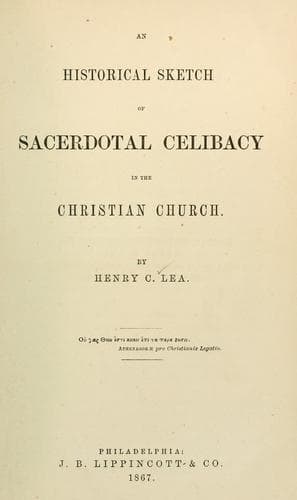
An Historical Sketch of Sacerdotal Celibacy in the Christian ChurchLea, Henry Charles
History
An Historical Sketch of Sacerdotal Celibacy in the Christian Church
Lea, Henry Charles
Catholic Church -- Clergy; Celibacy -- Catholic Church; Church history
In considering, however, the influence of the regular clergy, or
monastic orders, we find a more complex array of motives and results.
The earlier foundations of the West, as we have seen, to a great
extent neutralized the inherent selfishness of monachism by the
regulations which prescribed a due proportion of labor to be mingled
with prayer. The duty which man owes to the world was to some extent
recognized as not incompatible with the duty which he owed to his
God, and civilization has had few more efficient instruments than the
self-denying work of the earnest men who, from Columba to Adalbert,
sowed the seeds of Christianity and culture among the frontier
lands of Christendom. When discipline such as these men inculcated
could be enforced, the benefits of monachism far outweighed its
evils. All the peaceful arts, from agriculture to music, owed to the
Benedictines their preservation or their advancement, and it would be
difficult to estimate exactly the influence for good which resulted
from institutions to which the thoughtful and studious could safely
retire from a turbulent and barbarous world. These institutions,
however, from their own inherent defects, carried in them the germs
of corruption. The claims to supereminent sanctity, which secured for
them the privileges of asylums, were inevitably used as means for the
accumulation of wealth wrung from the fears or superstition of the
sinner. With wealth came the abandonment of labor; and idleness and
luxury were the prolific parents of license. True-hearted men were
not wanting to combat the irrepressible evil. From Chrodegang to St.
Vincent de Paul, the history of monachism is full of illustrious names
of those who devoted themselves to the mission of reforming abuses and
restoring the ideal of the perfect monk, dead to the seductions of the
world, and living only to do the work which he deems most acceptable to
God. Many of these mistakenly assumed that exaggerated mortification
was the only gateway to salvation, and the only cure for the frightful
immorality which pervaded so many monastic establishments. Others,
with a truer insight into the living principles of Christianity, sought
to turn the enthusiasm of their disciples to account in works of
perennial mercy and charity, at a period when no other organizations
existed for the succor of the helpless and miserable.
Public-domain text, read in full here on John Shaqi.
Reviews
Reviews
No reviews yet
Be the first to share your thoughts on this work.
Elsewhere in the archive
Join the Discussion
Join the discussion
Sign in to leave a comment or review.
Sign InorCreate an account