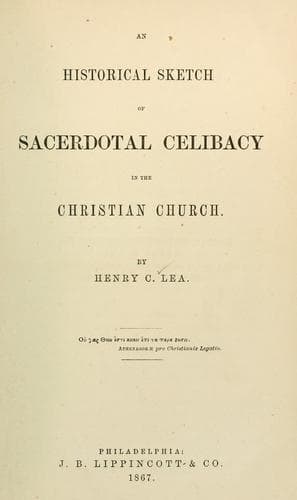
An Historical Sketch of Sacerdotal Celibacy in the Christian ChurchLea, Henry Charles
History
An Historical Sketch of Sacerdotal Celibacy in the Christian Church
Lea, Henry Charles
Catholic Church -- Clergy; Celibacy -- Catholic Church; Church history
Another result which may fairly be attributed to the ascetic teachings
of the church is the slow growth of population during the mediæval
period. Notwithstanding the gross and flagrant disregard of the rule,
it was impossible to immure in convents men and women by the hundred
thousand during successive generations without retarding greatly
the rate of increase of the species. The rudeness of the arts and
sciences, war, pestilence and famine were doubtless efficient causes,
yet were they less efficient than enforced celibacy. This is evident
when we see the rapid rate of growth established on the abrogation
or even relaxation of the rule. The suppression of the monastic
orders in France followed soon after the reforms by which Joseph II.
discouraged them throughout the Austrian empire, and the result is
visible in the enormous increase of European population which followed,
notwithstanding the fearful destruction of life in the Napoleonic
wars. It is calculated that in 1788 Europe numbered 144,561,000 souls,
which within fifty years had been augmented to 253,622,000, or about
seventy-five per cent. Of late years the birth-rate has decreased in
consequence of the severity of conscription in the military monarchies,
but the enormous growth in the half-century following the French
Revolution is the best commentary on the influences which for so many
ages kept the population almost stationary.[894]
* * * * *
It required the unbelief of the fifteenth century to give free rein
to the rising commercial energies and the craving for material
improvement that paved the way for the overthrow of ascetic
sacerdotalism. The fearful corruptions of the church, which indirectly
caused and accompanied that awakening of the human mind, will be
alluded to hereafter when we come to consider the movements leading to
the great Protestant Reformation. At present we must turn aside for a
moment to consider one or two external developments of the religious
activity of the Middle Ages.
XXII.
THE MILITARY ORDERS.
The Military Orders were the natural expression of the singular
admixture of religious and warlike enthusiasm, reacting on each
other, which produced and was fostered by the Crusades. When bishops
considered that they rendered a service acceptable to God in leading
vast hosts to slaughter the Paynim, it was an easy transition for
soldiers to turn monks, and to consecrate their swords to the bloody
work of avenging their Redeemer.
Public-domain text, read in full here on John Shaqi.
Reviews
Reviews
No reviews yet
Be the first to share your thoughts on this work.
Elsewhere in the archive
Join the Discussion
Join the discussion
Sign in to leave a comment or review.
Sign InorCreate an account