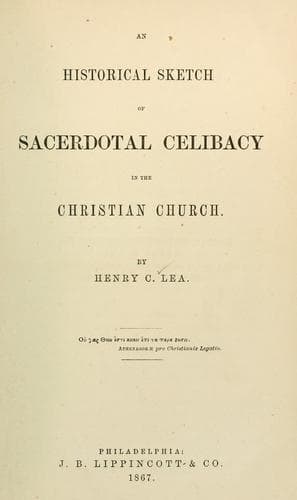
An Historical Sketch of Sacerdotal Celibacy in the Christian ChurchLea, Henry Charles
History
An Historical Sketch of Sacerdotal Celibacy in the Christian Church
Lea, Henry Charles
Catholic Church -- Clergy; Celibacy -- Catholic Church; Church history
When the Hospitallers—Knights of St. John of Jerusalem, of Rhodes,
or of Malta—first emerged from their humble position of ministering
to the afflictions of their fellow-pilgrims, and commenced to assume
a military organization under Raymond du Puy, about the year 1120,
their statutes required the three ordinary monastic vows of poverty,
obedience, and chastity.[895] In fact, they were at first Benedictines;
but when they became numerous enough to form a separate body, they
adopted the rule of St. Augustin.
When the rule for the Templars—“Regula pauperum commilitonum sanctæ
civitatis”—was adopted in 1128, at the council of Troyes, it contained
no special injunction to administer a vow of celibacy, but the context
shows that such a condition was understood as a matter of course.[896]
Some little difficulty was evidently experienced at first, since, from
the nature of the case, novices had to be trained warriors who must
frequently have been bound by family ties, and whose education had not
been such as to fit them for the restraints of their new life. It is
probable also that the perpetual nature of the obligations assumed was
not easy to be enforced upon the fierce members of the brotherhood,
for, in 1183, Lucius III., in confirming the privileges of the order,
specially commands that no one who enters it shall be allowed to return
to the world.[897]
The history of these two orders is too well known to require it to
be traced minutely here. If, with the growth of their reputation and
wealth, the austere asceticism of their early days was lost, and if
luxury and vice took the place of religious enthusiasm and soldierly
devotion to the Cross, they but obeyed the universal law which in
human institutions is so apt to render corruption the consequence of
prosperity. One conclusion may be drawn, however, from the proceedings
by which the powerful order of the Temple was extinguished at the
commencement of the fourteenth century. Notwithstanding the open and
scandalous licentiousness of the order, it is a little singular that
the interminable articles of accusation against the members contain
no allusion to unchastity, while crimes most fantastic, practices
most beastly, and charges most frivolous are heaped upon them in
strange confusion.[898] As the object of those who conducted the
prosecution was to excite a popular abhorrence that would justify the
purposed spoliation, it is evident that the simple infraction of vows
of chastity was regarded as so venial a fault and so much a matter
of course that its proof could in no way serve the end of rousing
indignation against the accused.
Public-domain text, read in full here on John Shaqi.
Reviews
Reviews
No reviews yet
Be the first to share your thoughts on this work.
Elsewhere in the archive
Join the Discussion
Join the discussion
Sign in to leave a comment or review.
Sign InorCreate an account