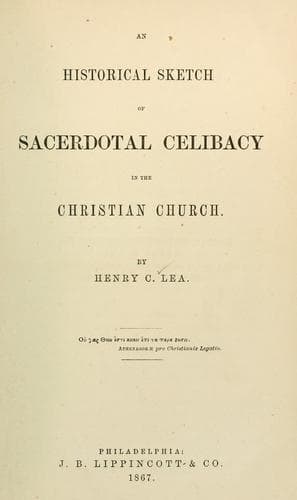
An Historical Sketch of Sacerdotal Celibacy in the Christian ChurchLea, Henry Charles
History
An Historical Sketch of Sacerdotal Celibacy in the Christian Church
Lea, Henry Charles
Catholic Church -- Clergy; Celibacy -- Catholic Church; Church history
Similar arguments were employed to extend the same privilege to the
Orders of Avis and of Jesus Christ, of Portugal. The former was founded
in 1147 by Alfonso I., under the Cistercian rule, and chastity was one
of its fundamental obligations;[904] the latter was the continuation of
the order of the Temple, which, preserved in Portugal by the humanity
of King Dionysius, assumed in the fourteenth century the name of Jesus.
Both institutions became incurably corrupted; their preceptories were
dens of avowed and scandalous prostitution, and their promiscuous
amours filled the kingdom with hate and dissension. When at length,
in 1496, King Emanuel applied to Alexander VI. to grant the privilege
of marriage, in hopes of reforming the orders, it is interesting to
observe how instinctively the minds of men turned to this as the sole
efficient remedy for the immorality which all united in attributing to
the hopeless attempt to enforce a purity impossible in the existing
condition of society. Alexander assented to the request, and bestowed
on the orders the right of marriage on the same conditions as those
enjoined on the Knights of St. James of the Sword.[905] It is true that
Osorius doubts whether the benefits of the change were not exceeded by
its evils, as he states that it lowered the character of the orders,
opened the door to unworthy members, and led to the dissipation of
their property.[906]
There was another Portuguese order of a somewhat different character.
Twenty years after founding the Knights of Avis, Alfonso I., in 1167,
to commemorate his miraculous victory over the Moors at Santarem,
instituted the Order of St. Michael. The knights were allowed to marry
once; if widowed, they were obliged to embrace celibacy; and the Abbot
of Alcobaça, who was the superior of the Order, was empowered to
excommunicate them for irregularity of life, to compel them to give
up their mistresses. They were moreover bound to perform the same
religious exercises as lay brothers of the Cistercians. The Order is
interesting as forming a curious link between the secular, religious,
and military elements of the period.[907]
During all this, the knights of St. John adhered to their ancient
statutes, and endeavored from time to time to reform the profligacy
which seemed inseparable from the institution. When the ascetic Antonio
Fluviano, who held the grand mastership from 1421 to 1437, promulgated
a regulation that any one guilty of public concubinage should receive
three warnings, with severe penalties for contumacy,[908] it suggests
a condition of morals by no means creditable to the brethren. So, a
century later, the stern Villiers de l’Isle-Adam was forced to declare
that any one openly acknowledging an illegitimate child should be
forever after incapacitated for office, benefice, or dignity.[909] What
the knights were soon afterwards, the scandalous pages of Brantôme
sufficiently attest.
Public-domain text, read in full here on John Shaqi.
Reviews
Reviews
No reviews yet
Be the first to share your thoughts on this work.
Elsewhere in the archive
Join the Discussion
Join the discussion
Sign in to leave a comment or review.
Sign InorCreate an account