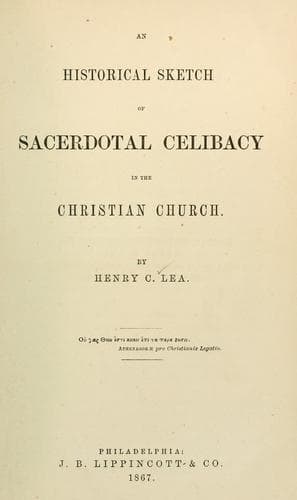
An Historical Sketch of Sacerdotal Celibacy in the Christian ChurchLea, Henry Charles
History
An Historical Sketch of Sacerdotal Celibacy in the Christian Church
Lea, Henry Charles
Catholic Church -- Clergy; Celibacy -- Catholic Church; Church history
It is somewhat remarkable that the same century which saw the
foundation of the orders of the Hospital and Temple also witnessed one
which, although bound by the rule of St. Augustin, and subjected to the
ordinary vows of obedience, property in common, and inability to return
to the world, yet allowed to its members the option of selecting either
marriage or celibacy, and even of contracting second marriages. This
was the Spanish Order of St. James of the Sword. What we have seen of
the want of respect paid by the Spanish church to asceticism may lessen
surprise at the founding of an order based upon such regulations, yet
it is difficult to understand how so great a violation of established
principles could be sanctioned by Alexander III., who confirmed the
order in 1175,[899] or by Innocent III. and Honorius III., who formally
approved its privileges.[900] Perhaps these military vassals of the
pope, to whom they were bound in implicit obedience as their head, were
too important a source of power and influence to be lightly rejected.
Perhaps, also, Honorius III. may have quieted his conscience when, in
confirming their charters in 1223, he commanded that their principal
care and watchfulness should be devoted to seeing that those who were
married preserved conjugal fidelity, and that those who elected a
single life maintained inviolable chastity.
The example was one of evil import in the Peninsula. The Council
of Valladolid in 1322 felt itself obliged to denounce under severe
penalties the practice of dowering children with the possessions of
the community, in which the military orders followed the precedent set
them by the church.[901] During the universal license of the fifteenth
century, when ascetic vows became a mockery, and the profligacy of
those who took them exposed all such observances to contempt, the
military orders formed no exception to the general shamelessness. In
1429 the council of Tortosa deplored the destruction and waste of
the temporal possessions of the religious knights from the general
concubinage in which they indulged, and to effect a cure it promulgated
regulations of peculiar severity, threatening with a liberal hand
the penalties of excommunication and degradation.[902] These proved
as powerless as usual, and not long after a more sensible remedy was
adopted by Eugenius IV. when he released the ancient and renowned Order
of Calatrava from the obligation of celibacy, for reasons which would
have led him to extend the privilege of marriage to the whole church,
had the purity of ecclesiastics been truly the object of the rule. He
recounts with sorrow the disorderly lives of the knights, and, quoting
the text which says that it is better to marry than to burn, he grants
the privilege of marriage because he deems it preferable to live with
a wife than with a mistress.[903] How could he avoid applying his own
reasoning to the church in general?
Public-domain text, read in full here on John Shaqi.
Reviews
Reviews
No reviews yet
Be the first to share your thoughts on this work.
Elsewhere in the archive
Join the Discussion
Join the discussion
Sign in to leave a comment or review.
Sign InorCreate an account