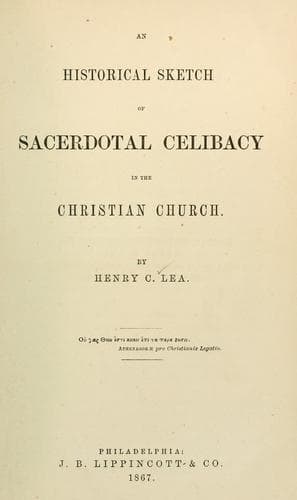
An Historical Sketch of Sacerdotal Celibacy in the Christian ChurchLea, Henry Charles
History
An Historical Sketch of Sacerdotal Celibacy in the Christian Church
Lea, Henry Charles
Catholic Church -- Clergy; Celibacy -- Catholic Church; Church history
Engrafted on these errors were others more practically dangerous,
as they were the inevitable protest against the all-absorbing
sacerdotalism which by this time had become the distinguishing
characteristic of the church. In denying the existence of purgatory,
and the efficacy of prayers for the dead and the invocation of saints,
a mortal blow was aimed against the system to which the church owed
its firmest hold on the souls and purses of the people. In reviving
the Hildebrandine doctrine that the sacraments were not to be
administered by ecclesiastics in a state of sin, and in exaggerating
it into an incompatibility between sin and holding church preferment,
a most dangerous and revolutionary turn was given to the wide-spread
discontent with which the excesses of the clergy were regarded.[913]
So sure a hold, indeed, had such views upon the popular feeling, that
we find them reappear with every heresy, transmitted with regular
filiation through the Waldenses, the Wickliffites, and the Hussites, so
that in every age, from Gregory to the Reformation, the measures with
which he broke down the independence of the local clergy returned to
plague their inventors.
Yet with all this, the heretics to outward appearance long continued
unexceptionably orthodox. Industrious and sober, none were more
devoted to all the observances of the church, none more regular at
mass and confessional, more devout at the altar or more liberal at the
offertory. Hidden beneath this fair seeming, their heresy was only the
more dangerous, as it attracted converts with unexampled rapidity.
Priests gave up their churches to join the society, wives left their
husbands, and husbands abandoned their wives; and when questioned as
to their renunciation of the duties and privileges of marriage, they
all professed to be bound with a vow of chastity. Yet if so ardent a
combatant as St. Bernard is to be believed, their rigorous asceticism
was only a cloak for libertinism. It is possible that the enthusiastic
self-mortification of the sectaries led them to test their resolution
by the dangerous experiments common among the early Christians, and
possibly also with the same deplorable results. St. Bernard at least
argues that constant companionship of the sexes without sin would
require a greater miracle than raising the dead, and as these heretics
could not perform the lesser prodigy, it was reasonable to presume
that they failed of the greater—and his conclusion is not unlikely
to be true.[914] Be this as it may, the virtue of these puritan sects
rendered chastity dangerous to the orthodox, for the celebrated Peter
Cantor relates as a fact within his own knowledge, that honest matrons
who resisted the attempts of priests to seduce them were accused of
Manichæism and condemned as heretics.[915]
Public-domain text, read in full here on John Shaqi.
Reviews
Reviews
No reviews yet
Be the first to share your thoughts on this work.
Elsewhere in the archive
Join the Discussion
Join the discussion
Sign in to leave a comment or review.
Sign InorCreate an account