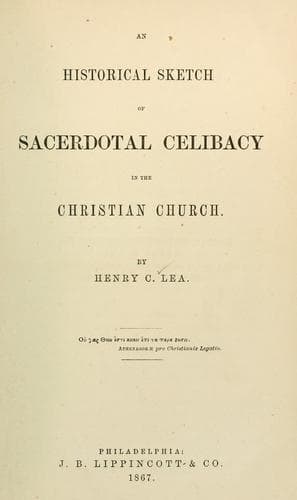
An Historical Sketch of Sacerdotal Celibacy in the Christian ChurchLea, Henry Charles
History
An Historical Sketch of Sacerdotal Celibacy in the Christian Church
Lea, Henry Charles
Catholic Church -- Clergy; Celibacy -- Catholic Church; Church history
The orthodox polemics, in controverting the exaggerated asceticism of
these heretics, had a narrow and a difficult path to tread. Their own
authorities had so exalted the praises of virgin purity, that it was
not easy to meet the arguments of those who merely carried out the same
principle somewhat further, in fearlessly following out the premises to
their logical conclusion.[916] There is extant a curious tract, being
a dialogue between a Catholic and a Paterin, in which the latter of
course has the worst of the disputation, yet he presses his adversary
hard with the texts which were customarily cited by the orthodox
advocates of clerical celibacy—“qui habent uxores sint tanquam non
habentes,” “qui non reliquerit uxorem et filios propter me non est me
dignus,” &c.; and the Catholic can only elude their force by giving to
them metaphorical explanations very different from those which of old
had been assumed in the canons requiring the separation of man and wife
on ordination.[917]
The stubborn resistance of the Albigenses to the enormous odds brought
against them shows the unconquerable vitality of the antisacerdotal
spirit which was then so widely diffused throughout Southern Europe.
In a different shape it had already manifested itself during the first
half of the twelfth century, when Pierre de Bruys infected all the
South of France with the heresy called, after him and his most noted
follower, the Petrobrusian or Henrician. This was an uncompromising
revolt against the whole system of Roman Christianity. It not only
abrogated pædo-baptism, and promulgated heretical notions respecting
the Eucharist, but it abolished the visible symbols and ceremonies
which formed so large a portion of the sacerdotal fabric—churches,
crucifixes, chanting, fasting, gifts and offerings for the dead, and
even the mass. But little is known respecting the Petrobrusians,
except what can be derived from the refutation of their errors by
Peter the Venerable. He says nothing specifically respecting their
views upon ascetic celibacy, but we may assume that this was one of
the doctrinal and practical corruptions which they assailed, from
a passage in which, describing their excesses, he complains of the
public eating of flesh on Passion Sunday, the cruel flagellation of
priests, the imprisonment of monks, and their being forced to marry by
threats and torments. Even after de Bruys was burned alive in 1146, his
disciple, Henry, boldly carried on the contest, and the papal legate,
Cardinal Alberic, sent for St. Bernard to assist him in suppressing
the heretics. The latter, in a letter written in 1147 to the Count of
Toulouse, describes the religious condition of his territories as most
deplorable in consequence of the prevalence of the heresy—the churches
were without congregations, the pastors without flocks, the people
without pastors, the sacraments without reverence, the dying without
consolation, and the new-born without baptism. Even making allowance
Public-domain text, read in full here on John Shaqi.
Reviews
Reviews
No reviews yet
Be the first to share your thoughts on this work.
Elsewhere in the archive
Join the Discussion
Join the discussion
Sign in to leave a comment or review.
Sign InorCreate an account