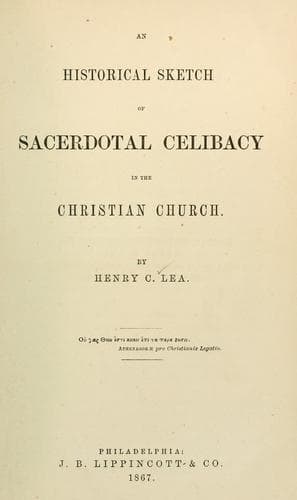
An Historical Sketch of Sacerdotal Celibacy in the Christian ChurchLea, Henry Charles
History
An Historical Sketch of Sacerdotal Celibacy in the Christian Church
Lea, Henry Charles
Catholic Church -- Clergy; Celibacy -- Catholic Church; Church history
Connected probably in some way with these movements of insubordination,
was the career of the singular heresiarch, Éon de l’Étoile. During one
of the epidemics of maceration and fanaticism which form such curious
episodes in mediæval history, Éon, born of a noble Breton family,
abandoned himself to the savage life of a hermit in the wilderness.
Drawn by a vision to attend divine service, his excited mysticism
caught the words which ended the recitation of the collect, “Per _eum_
qui venturus est judicare vivos et mortuos;” and the resemblance of
“eum” with his own name inspired him with the revelation that he was
the Son of God. Men’s minds were ready for any extravagance, and Éon
soon had disciples who adored him as a deity incarnate. Nothing can be
wilder than the tales which are related of him by eye-witnesses—the
aureole of glory which surrounded him, the countless wealth which
was at the disposal of his followers, the rich but unsubstantial
banquets which were served at his bidding by invisible hands, the
superhuman velocity of his movements when eluding those who were bent
on his capture. Éon declared war upon the churches which monopolized
the wealth of the people while neglecting the duties for which they
had been enriched; and he pillaged them of their treasures, which he
distributed lavishly to the poor. At last the Devil abandoned his
protégé. Éon, when his time had come, was easily taken and carried
before Eugenius III. at the Council of Rouen, in 1148. There he boldly
proclaimed his mission and his power. Exhibiting a forked staff which
he carried, he declared that when he held it with the fork upwards,
God ruled heaven and hell, and he governed the earth; but that when
he reversed its position, then he had at command two-thirds of the
universe, and left only the remaining third to God. He was pronounced
hopelessly insane, but this would not have saved him had not his
captor, the Archbishop of Rheims, represented that his life had been
pledged to him on his surrender. He was therefore, delivered to Suger,
Abbot of St. Denis, to be imprisoned, and he soon afterwards died.
Even this did not shake the faith of his disciples. Many of them,
in their fierce fanaticism, preferred the stake to recantation, and
numbers of them were thus put to death before the heresy could be
extinguished.[921]
* * * * *
Public-domain text, read in full here on John Shaqi.
Reviews
Reviews
No reviews yet
Be the first to share your thoughts on this work.
Elsewhere in the archive
Join the Discussion
Join the discussion
Sign in to leave a comment or review.
Sign InorCreate an account