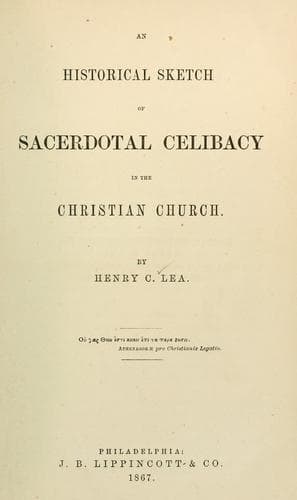
An Historical Sketch of Sacerdotal Celibacy in the Christian ChurchLea, Henry Charles
History
An Historical Sketch of Sacerdotal Celibacy in the Christian Church
Lea, Henry Charles
Catholic Church -- Clergy; Celibacy -- Catholic Church; Church history
for some exaggeration in all this, there can be no doubt that the
heresy received extensive popular support and that it was professed
publicly without disguise. At Alby it was dominant, so that when the
Cardinal-legate went there, the people received him in derision with
asses and drums, and when he preached, scarce thirty persons assembled
to hear him; but two days later St. Bernard so affected them with his
eloquence that they renounced their errors. He was less successful
at Vertfeuil where resided a hundred knights-banneret, who refused
to listen to him, and whom he cursed in consequence, whereof they
all perished miserably. Though St. Bernard was forced to return to
Clairvaux without accomplishing the extirpation of the heresy, Henry
was finally captured, and probably died in prison.[918]
In Britanny, about the same period, there existed an obscure sect
concerning whom little is known, except that they were probably a
branch of the Petrobrusians. Their errors were nearly the same,
and the slender traces left of them show that their doctrine was a
protest against the overwhelming sacerdotalism of the period. The
papal legate, Hugh, Archbishop of Rouen, sought to convert them by
an elaborate denunciation of their tenets, among which he enumerates
promiscuous licentiousness and disregard of clerical celibacy. Daniel,
he gravely assures them, symbolizes virginity; Noah, continence; and
Job, marriage. Then, quoting Ezekiel XIV. 13-20, wherein Jehovah,
threatening the land with destruction, says, “Though these three men,
Noah, Daniel, and Job, were in it, they should deliver but their own
souls through their righteousness,” he proceeds triumphantly to the
conclusion that recantation alone can save his adversaries from the
fate which their errors have deserved.[919]
It was probably another branch of the same sect which was discovered
at Liége in 1144, described as brought thither from the south and
pervading all France and the neighboring countries. Its followers
denied the efficacy of baptism, of the Eucharist and of the imposition
of hands; they rejected not only oaths and vows, but marriage itself,
and denied that the Holy Spirit could be gained except through
good works. These heretics, however, had not in them the spirit of
martyrdom, and speedily recanted on being discovered.[920]
Public-domain text, read in full here on John Shaqi.
Reviews
Reviews
No reviews yet
Be the first to share your thoughts on this work.
Elsewhere in the archive
Join the Discussion
Join the discussion
Sign in to leave a comment or review.
Sign InorCreate an account