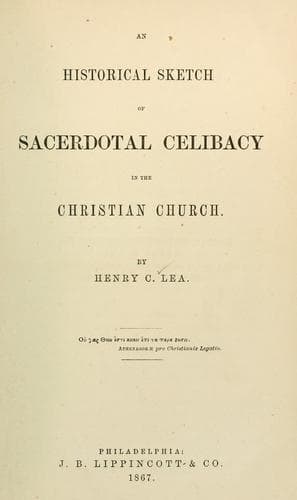
An Historical Sketch of Sacerdotal Celibacy in the Christian ChurchLea, Henry Charles
History
An Historical Sketch of Sacerdotal Celibacy in the Christian Church
Lea, Henry Charles
Catholic Church -- Clergy; Celibacy -- Catholic Church; Church history
The antisacerdotal spirit, however, did not develop itself altogether
in opposition to the church. Devout and earnest men there were, who
recognized the evil resulting from the overgrown power and wealth of
the ecclesiastical establishment, without shaking off their reverence
for its doctrine and its visible head, and the authorities at length
saw in these men the effective means of combating the enemy. In thus
availing themselves of one branch of the reformers to destroy the other
and more radical portion, the chiefs of the hierarchy were adopting an
expedient effective for the present, yet fraught with danger for the
future. The Franciscans and Dominicans were useful beyond expectation.
They restored to the church much of the popular veneration which had
become almost hopelessly alienated from it, and their wonderfully
rapid extension throughout Europe shows how universally the people had
felt the want of a religion which should fitly represent the humility,
the poverty, the charity of Christ. Yet when Innocent III. hesitated
long to sanction the mendicant orders, he by no means showed the
want of sagacity which has been so generally asserted by superficial
historians; rather, like Lucius III. with the Waldenses, his far-seeing
eye took in the possible dangers of that fierce ascetic enthusiasm
which might at any moment break the bonds of earthly obedience, when
its exalted convictions should declare that obedience to man was revolt
against God.
Before the century was out, the result was apparent. When St.
Francis erected poverty into an object of adoration, attaching to
it an importance as insane as that attributed to virginity by the
early ascetics, he at once placed himself in opposition to the whole
system of the church establishment, though his exquisite humility
and exhaustless charity might disguise the dangerous tendency of
his doctrines.[929] As his order grew in numbers and wealth with
unexampled rapidity, it necessarily declined from the superhuman
height of self-abnegation of which its founder was the model. Already,
in 1261, the council of Mainz can hardly find words severe enough to
condemn the mendicant friars who wandered around selling indulgences
and squandering their unhallowed gains in the vilest excesses. One of
these lights of the order publicly preached, in the horse-market of
Strassburg, the doctrine that a nun who surrendered her virtue to a
monk was less guilty than if she had an intrigue with a layman.[930]
This falling from grace naturally produced dissatisfaction among
those impracticable spirits who still regarded St. Francis as their
exemplar as well as their patron. The breach gradually widened, until
at length two parties were formed in the order. The ascetics finally
separated themselves from their corrupted brethren, and under the
name of Begghards in Germany, Frèrots in France, and Fraticelli in
Southern Europe, assumed the position of being the only true church.
Public-domain text, read in full here on John Shaqi.
Reviews
Reviews
No reviews yet
Be the first to share your thoughts on this work.
Elsewhere in the archive
Join the Discussion
Join the discussion
Sign in to leave a comment or review.
Sign InorCreate an account