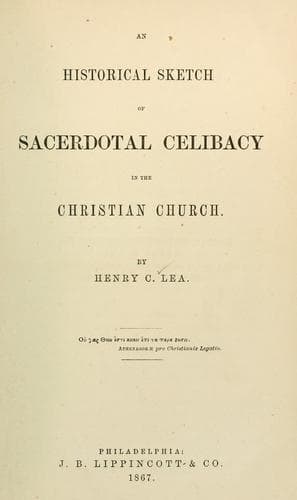
An Historical Sketch of Sacerdotal Celibacy in the Christian ChurchLea, Henry Charles
History
An Historical Sketch of Sacerdotal Celibacy in the Christian Church
Lea, Henry Charles
Catholic Church -- Clergy; Celibacy -- Catholic Church; Church history
Their excommunication at the council of Vienne, in 1311, in no wise
disconcerted them. The long-forgotten doctrines of Arnold of Brescia
were revived and intensified. Poverty was an absolute necessity to
true Christianity; the holding of property was a heresy, and the Roman
church was consequently heretic. Rome, indeed, was openly denounced as
the modern Babylon.
While thus carrying out to its necessary consequences the
sanctification of poverty, which was the essence of Franciscanism, they
were equally logical with regard to the doctrines of ascetic purity
which had been so earnestly enforced by the church. Their admiration
of virginity thus trenched closely on Manichæism, and in combating
their errors the church was scarcely able to avoid condemning both
the vow of poverty and that of celibacy, which were the corner-stones
of the monastic theory.[931] Active persecution, of course, aroused
equally active resistance. The Fraticelli espoused the cause of the
Emperor Louis of Bavaria, in his long and disastrous quarrel with John
XXII., whom they did not hesitate to excommunicate. Exterminated after
a prolonged and desperate struggle, their memory was blackened with
the slanders disseminated by a priesthood incapable of emulating their
ascetic virtues; and principal among these slanders was the accusation
which we find repeated on all occasions when an adversary is to be
rendered odious—that of promiscuous and brutal licentiousness. No
authentic facts, however, can be found to substantiate it.[932]
The Fraticelli form a connecting link in the generations of heresy.
Their errors, as taught by one of their most noted leaders, Walter
Lolhard, who was burned at Cologne in 1322, had a tinge of the
Manichæism of the Albigenses, for Satan was to them an object of
compassion and veneration.[933] Their prevalence in Bohemia prepared
the ground for Huss, and left deep traces in the popular mind which
were not eradicated in the eighteenth century; while their proselytes
in England served to swell the party of Wickliffe, and eventually
gave to it their name, though their peculiar doctrines bore little
resemblance to his.[934] Antisacerdotalism, however, was the common
tie, and in this Luther, Zwingli, and Knox were the legitimate
successors of Dolcino and Michael di Cesena.
Public-domain text, read in full here on John Shaqi.
Reviews
Reviews
No reviews yet
Be the first to share your thoughts on this work.
Elsewhere in the archive
Join the Discussion
Join the discussion
Sign in to leave a comment or review.
Sign InorCreate an account