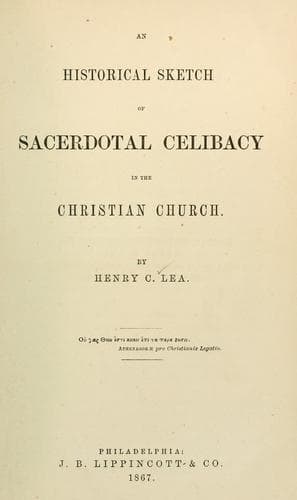
An Historical Sketch of Sacerdotal Celibacy in the Christian ChurchLea, Henry Charles
History
An Historical Sketch of Sacerdotal Celibacy in the Christian Church
Lea, Henry Charles
Catholic Church -- Clergy; Celibacy -- Catholic Church; Church history
The principal feature of his history which concerns us is the
good-natured indifference with which Alexander VI. endured his repeated
attacks on the scandals and vices of the papal court. There were so
many political interests entangled in Savonarola’s career that it is
not always easy to reach the hidden springs of action at work, but it
may be assumed that Alexander, if left to himself, would have allowed
the reformer to declaim unmolested. More than once he interdicted the
Dominican from preaching and ordered him to Rome, but took little
heed of disobedience. At length he launched an excommunication, which
for nearly a year received as little respect as his previous orders,
and when at length a sudden revulsion of feeling among the Florentine
mob enabled him to dispose of his adversary under the forms of law,
it is probable that even then he would not have pushed matters to
such extremity had not Savonarola been led to an act of aggressive
rebellion. The Duke of Milan forwarded to the pope intercepted letters
in which the reformer, by command of God, urged the monarchs of Europe
to call a general council under pretext that the church was without
a head, since Alexander was an infidel who had obtained the tiara by
simony and had polluted it with unimaginable vices. In his capacity
of prophet, Savonarola promised the rulers triumph over their enemies
if they would aid in the good work of cleansing the church, and he
engaged to prove before the council the truth of his allegations by
working miracles.[961] It would probably be unjust to condemn him as
an imposter, but such conclusion is only to be escaped by pronouncing
him partially insane. That fierce age was not apt to invoke such
considerations in palliation of so flagrant an attempt at revolution,
and Savonarola was doomed.
* * * * *
While thus trampling out these successive revolts, the church was
blind to the lesson taught by their perpetual recurrence. The minds of
men were gradually learning to estimate at its true value the claim
of the hierarchy to veneration, and at the same time the vices of the
establishment were yearly becoming more odious, and its oppression
more onerous. The explosion might be delayed by attempts at partial
reformation, but it was inevitable.
XXIV.
THE FIFTEENTH CENTURY.
Public-domain text, read in full here on John Shaqi.
Reviews
Reviews
No reviews yet
Be the first to share your thoughts on this work.
Elsewhere in the archive
Join the Discussion
Join the discussion
Sign in to leave a comment or review.
Sign InorCreate an account