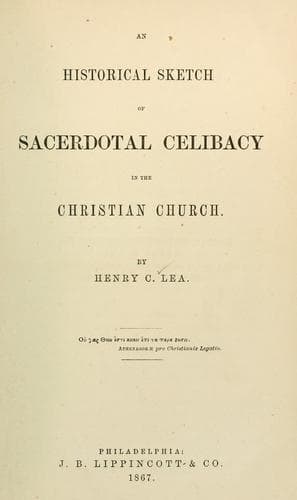
An Historical Sketch of Sacerdotal Celibacy in the Christian ChurchLea, Henry Charles
History
An Historical Sketch of Sacerdotal Celibacy in the Christian Church
Lea, Henry Charles
Catholic Church -- Clergy; Celibacy -- Catholic Church; Church history
Wickliffe and Huss were not the only inheritors of the antisacerdotal
spirit of the Fraticelli. About the close of the fourteenth century
there arose in Thuringia a heresiarch of the flagellants named Conrad
Schmidt, whose teachings swept away the forms and observances which
had so thickly incrusted the simple doctrines of Christianity. The
sacrifice of the mass, image-worship, fasting, feasts, purgatory,
confession, and absolution, all fell before the fearless logic of the
reformer, and his disciples fondly treasured him in memory as a second
incarnation of Enoch. For forty years the sect flourished in secret,
but at length it was discovered in Misnia, where its members were known
as Brethren of the Cross, and where it was exterminated in 1414 by the
fagots of Sangerhausen. The licentious doctrines attributed to them
by the monkish chronicler show that sacerdotal celibacy was one of
the observances which they repudiated.[958] Similar in its tendency,
and almost identical in details, was the heresy which, in 1411, was
condemned in Flanders by Peter d’Ailly, Archbishop of Cambrai. Giles
Cantor, a layman, and a Carmelite known as William of Hilderniss
gathered around them followers who assumed the title of Men of
Intelligence. Like Conrad Schmidt, they rejected the empty formalism
which had to so great an extent usurped the place of religion. The
Atonement had satisfied God for all; there was no necessity for the
intervention of sacerdotal ministrations, for confession and absolution
were useless, Christ was not present in the sacrament, purgatory did
not exist, and all mankind, besides the fallen angels, would in the end
be saved. There was, however, little of the temper of martyrs about
them, and a public renunciation of their errors at Brussels speedily
deprived them of all importance.[959]
* * * * *
Savonarola can scarcely be classed among heretics. Though he was
tortured and put to death by the church for his rebellious attempts to
purify it, still his doctrines never varied from strict orthodoxy, and
Benedict XIV. even included him in a catalogue of the holy servants of
God.[960] Yet Savonarola, when his career was cut short, was rapidly
becoming a schismatic, as was inevitable with all reformers of ardent
temperament as soon as they discovered the impossibility of removing
the corruptions of the establishment. If, instead of the fickle
support of the Florentine populace, which betrayed him at his utmost
need, he had enjoyed the steadfast protection of such a patron as the
Elector Frederic of Saxony, he would doubtless have ripened in time,
as Luther subsequently did, into a full-blown heresiarch, though his
innate defects of character would scarcely have enabled him, under any
circumstances, to conduct successfully so complicated a movement as a
separation from the church.
Public-domain text, read in full here on John Shaqi.
Reviews
Reviews
No reviews yet
Be the first to share your thoughts on this work.
Elsewhere in the archive
Join the Discussion
Join the discussion
Sign in to leave a comment or review.
Sign InorCreate an account