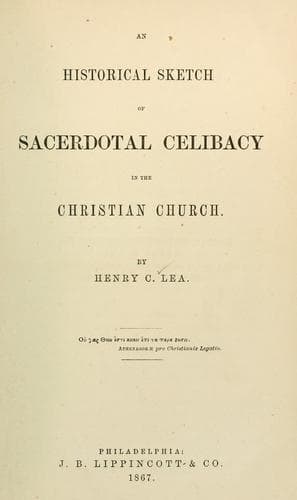
An Historical Sketch of Sacerdotal Celibacy in the Christian ChurchLea, Henry Charles
History
An Historical Sketch of Sacerdotal Celibacy in the Christian Church
Lea, Henry Charles
Catholic Church -- Clergy; Celibacy -- Catholic Church; Church history
Another object may not improbably have entered into the motives of
those who introduced the rule. The church was daily receiving vast
accessions of property from the pious zeal of its wealthy members, the
death-bed repentance of despairing sinners, and the munificence of
emperors and prefects, while the effort to procure the inalienability
of its possessions dates from an early period.[109] Its acquisitions,
both real and personal, were of course exposed to much greater
risk of dilapidation when the ecclesiastics in charge of its widely
scattered riches had families for whose provision a natural parental
anxiety might be expected to override the sense of duty in discharging
the trust confided to them. The simplest mode of averting the danger
might therefore seem to be to relieve the churchman of the cares of
paternity, and, by cutting asunder all the ties of family and kindred,
to bind him completely and forever to the church and to that alone.
This motive, as we shall see, was openly acknowledged as a powerful
one, in later times, and it no doubt served as an argument of weight in
the minds of those who urged and secured the adoption of the canon.
It appears to me not unreasonable to suppose that all these various
motives lent additional force to the zeal for the purity of the
church, and to the undoubting belief in the necessity of perpetual
celibacy, which impelled the popes, about the year 385, to issue the
first definite command imposing it as an absolute rule of discipline
on the ministers of the altar. The question evidently was one which
largely occupied the minds of men, and the conclusion was reached
progressively. A Roman synod, to which the date of 384 is assigned,
answered a series of interrogatories propounded by the bishops of Gaul,
among which was one relating to the chastity of the priesthood. To this
the response was rather argumentatory and advisory in its character
than imperative; the continence of the higher grades of ecclesiastics
was insisted on, but no definite punishment was ordered for its
violation[110]—and no maxim in legislation is better understood than
that a law without a penalty expressed is practically a dead letter.
Allusion was made to previous efforts to enforce the observance in
various churches; surprise was expressed that light should be sought
for on such a question—for the Gallic prelates had evidently been in
doubt respecting it—and numerous reasons were alleged in a manner to
show that the subject was as yet open to argument, and could not be
assumed as proved or be decided by authority alone. These reasons may
be briefly summed up as consisting of references to the well-known
texts referred to in a previous section, together with a vague
assertion of the opinion of the Fathers to the same effect. Allusion
was made to the inconsistency of exhortations to virginity proceeding
from those who themselves were involved in family cares and duties, a
Public-domain text, read in full here on John Shaqi.
Reviews
Reviews
No reviews yet
Be the first to share your thoughts on this work.
Join the Discussion
Join the discussion
Sign in to leave a comment or review.
Sign InorCreate an account