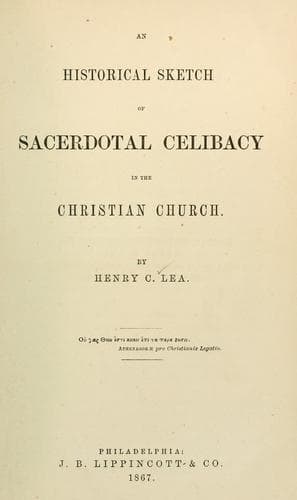
An Historical Sketch of Sacerdotal Celibacy in the Christian ChurchLea, Henry Charles
History
An Historical Sketch of Sacerdotal Celibacy in the Christian Church
Lea, Henry Charles
Catholic Church -- Clergy; Celibacy -- Catholic Church; Church history
reasonable view when we consider how much of ecclesiastical machinery
by this time turned on monachism; and the necessity was urged of
bishops, priests, and deacons preserving the purity requisite to fit
them for the daily sacrifice of the altar and the ministration of
the sacraments. This latter point was based upon the assumption of a
similar abstinence being imposed by the old law on the Levites during
their term of service in the Temple, and the example of the pagan
priesthood was indignantly adduced to shame those who could entertain a
sacrilegious doubt upon a matter so self-evident.[111] The conclusion
arrived at was definite, but, as I have already remarked, no means were
suggested or commanded for its enforcement.
Not many months later Pope Damasus died, but the cause was safe in the
hands of his successor. Scarcely had Siricius ascended the pontifical
throne, when, in 385, he addressed an epistle to Himerius, Archbishop
of Tarragona, expressing his grief and indignation that the Spanish
clergy should pay so little regard to the sanctity of their calling
as to maintain relations with their wives. It is evident from the
tenor of the decretal that Himerius had been unable to enforce the new
discipline, and had appealed to Rome for assistance in breaking down
the stubborn resistance which he had encountered, for allusion is made
to some of the refractory who had justified themselves by the freedom
of marriage allowed to the Levites under the old law, while others had
expressed their regret and had declared their sin to be the result of
ignorance. Siricius adopted a much firmer tone than his predecessor.
He indulged in less elaboration of argument; a few texts, more or less
apposite; an expression of wonder that the rule should be called in
question; a distinct assertion of its application to the three grades
of bishops, priests, and deacons; a sentence of expulsion on all who
dared to offer resistance, and a promise of pardon for those who had
offended through ignorance, allowing them to retain their positions
as long as they observed complete separation from their wives, though
even then they were pronounced incapable of all promotion—such was the
first definitive canon, prescribing and enforcing sacerdotal celibacy,
exhibited by the records of the church.[112]
Public-domain text, read in full here on John Shaqi.
Reviews
Reviews
No reviews yet
Be the first to share your thoughts on this work.
Join the Discussion
Join the discussion
Sign in to leave a comment or review.
Sign InorCreate an account