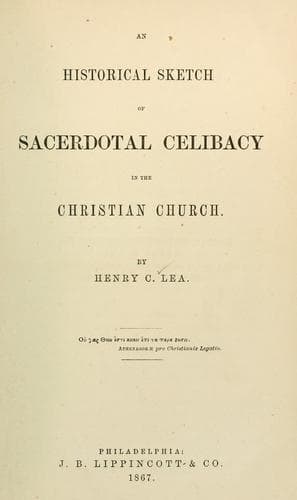
An Historical Sketch of Sacerdotal Celibacy in the Christian ChurchLea, Henry Charles
History
An Historical Sketch of Sacerdotal Celibacy in the Christian Church
Lea, Henry Charles
Catholic Church -- Clergy; Celibacy -- Catholic Church; Church history
time for them to have an historical value, even when divested of their
miraculous ornaments. They bring before us the popular tendencies and
modes of thought, and show us how powerful an instrument the passions
of the people became, when skilfully aroused and directed by those in
authority.
* * * * *
The Western church was thus at length irrevocably committed to the
strict maintenance of ecclesiastical celibacy, and the labors of the
three great Latin Fathers, Jerome, Ambrose, and Augustin, were crowned
with success. It is perhaps worth while to cast a glance at such
evidences as remain to us of the state of morals about this period
and during the fifth century, and to judge whether the new rule of
discipline had resulted in purifying the church of the corruptions
which had so excited the indignation of the anchorite of Bethlehem,
and had nerved him in his fierce contests with those who opposed the
enforced asceticism of the ministers of Christ.
How the morals of the church fared during the struggle is well
exhibited in the writings of St. Jerome himself, as quoted above,
describing the unlawful unions of the agapetæ with ecclesiastics
and the horrors induced by the desire to escape the consequences of
incautious frailty. Conclusions not less convincing may be drawn from
his assertion that holy orders were sometimes assumed on account of the
superior opportunities which clericature gave of improper intercourse
with women;[143] and from his description of the ecclesiastics, who
passed their lives in female companionship, surrounded by young female
slaves, and leading an existence which differed from matrimony only in
the absence of the marriage ceremony.[144]
But a short time after the recognition of the rule appeared the law of
Honorius, promulgated in 420, to which reference has already been made.
It is possible that the permission of residence there granted to the
wives of priests may have been intended to act as a partial cure to
evils caused by the enforcement of celibacy; and this is rendered the
more probable, since other portions of the edict show that intercourse
with improper females had increased to such a degree that the censures
of the church could no longer restrain it, and that an appeal to
secular interference was necessary, by which such practices should be
made a crime to be punished by the civil tribunals.[145] That even this
failed lamentably in purifying the church may be gathered from the
proceedings of the provincial councils of the period.
Public-domain text, read in full here on John Shaqi.
Reviews
Reviews
No reviews yet
Be the first to share your thoughts on this work.
Elsewhere in the archive
Join the Discussion
Join the discussion
Sign in to leave a comment or review.
Sign InorCreate an account