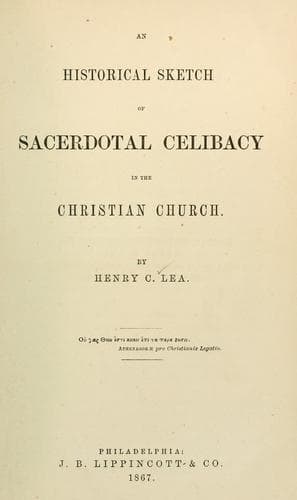
An Historical Sketch of Sacerdotal Celibacy in the Christian ChurchLea, Henry Charles
History
An Historical Sketch of Sacerdotal Celibacy in the Christian Church
Lea, Henry Charles
Catholic Church -- Clergy; Celibacy -- Catholic Church; Church history
Thus, in 453, the council of Anjou repeats the prohibition of improper
female intimacy, giving as a reason the ruin constantly wrought by it.
For those who thereafter persisted in their guilt, however, the only
penalty threatened was incapacity for promotion on the part of the
lower grades, and suspension of functions for the higher[146]—whence
we may conclude that practically an option was afforded to those
who preferred sin to ambition. The second council of Arles, in 443,
likewise gives an insight into the subterfuges adopted to evade the
rule and to escape detection.[147] About this period a newly-appointed
bishop, Talasius of Angers, applied to Lupus of Troyes and Euphronius
of Autun for advice concerning various knotty points, among which were
the rules respecting the celibacy of the different grades. In their
reply the prelates advised their brother that it would be well if
the increase of priests’ families could be prevented, but that such
a consummation was almost impossible if married men were admitted to
orders, and that if he wanted to escape ceaseless wrangling and the
scandal of seeing children born to his priests, he had better ordain
those only who were single.[148] The subject was one of endless effort.
In fact, of the numerous councils whose canons have reached us, held in
Gaul and Spain during the centuries which intervened until the invasion
of the Saracens and the decrepitude of the Merovingian dynasty caused
their discontinuance, there is scarcely one which did not feel the
necessity of legislating on this delicate matter. It would be tedious
and unprofitable to detail specifically the innumerable exhortations,
threats, and ingenious devices resorted to in the desperate hope of
enforcing obedience to the rules and of purifying the morals of the
clergy. Suffice it to say that the constantly varying punishments
enacted, the minute supervision ordered over every action of the
priesthood, the constant attendance of witnesses whose inseparable
companionship should testify to the virtue of each ecclesiastic, and
the perpetual iteration of the rule in every conceivable shape, prove
at once the hopelessness of the attempt, and the incurable nature of
the disorders of which the church was at once the cause and the victim.
In short, this perpetual legislation frequently betrays the fact that
it was not only practically impossible to maintain separation between
the clergy and their wives, but that at times marriage was not uncommon
even within the prohibited orders.[149]
Public-domain text, read in full here on John Shaqi.
Reviews
Reviews
No reviews yet
Be the first to share your thoughts on this work.
Elsewhere in the archive
Join the Discussion
Join the discussion
Sign in to leave a comment or review.
Sign InorCreate an account